


© Stadt Bocholt
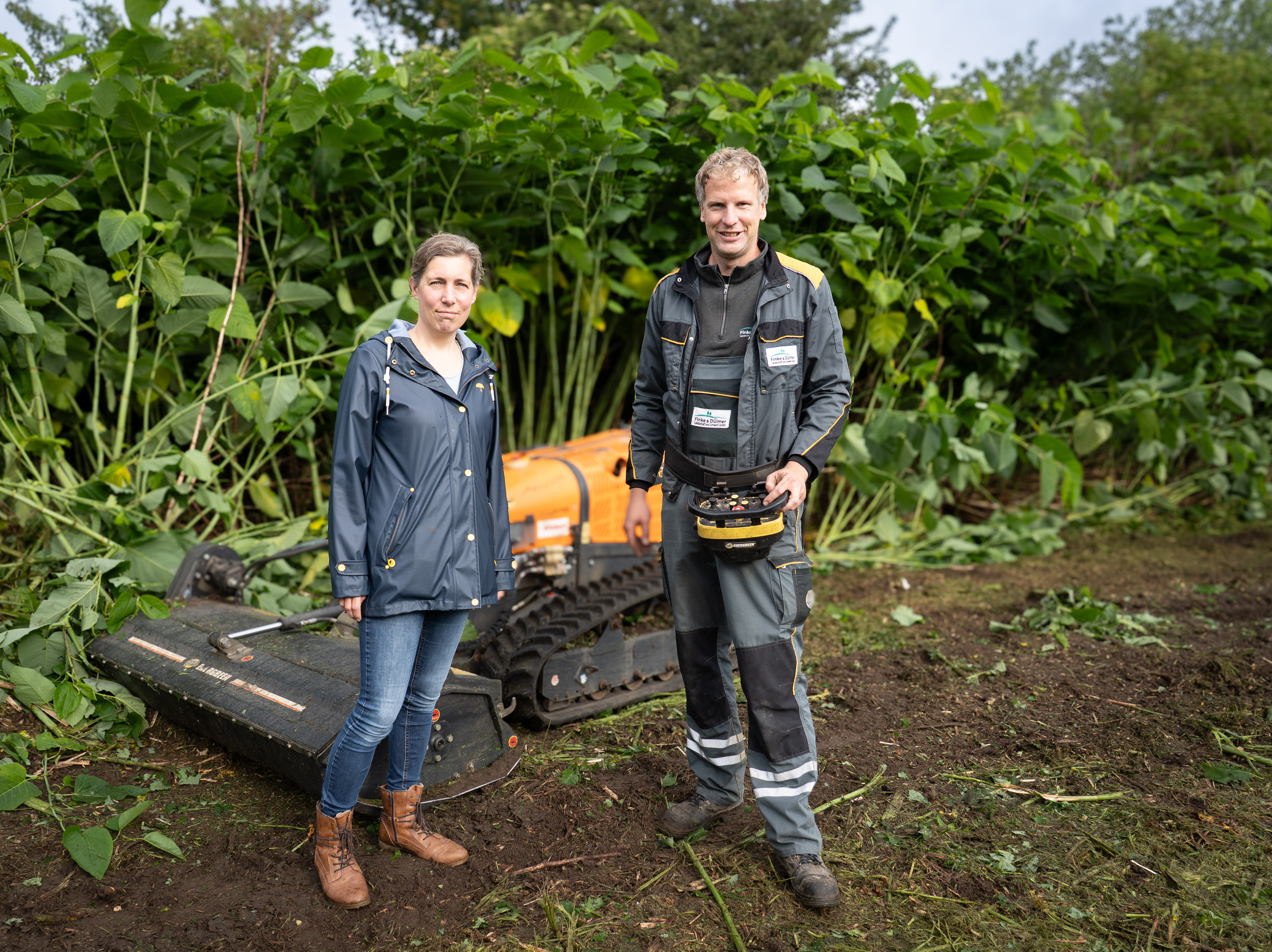
Caroline Bücher, from the Urban Greenery and Environment Department at Bocholt City Council, and Jan Finke, Managing Director of the contracted firm Landschaft und Umwelt GmbH, in front of the giant knotweed on the site on Ostring.The town of Bocholt is trialling a new method to combat invasive plant species
Participation in the inter-municipal LEADER project // Controlling Sakhalin knotweed on a trial plot on Ostring
- The town of Bocholt is taking active steps to combat the spread of invasive plant species and is launching a targeted control programme on a test site near the Ostring. As part of an inter-municipal LEADER project, efforts are being made there to control Sakhalin knotweed using a combined method of repeated cutting and soil replacement. The project will run until 2028 and is intended to provide practical insights for sustainable nature conservation.
Two invasive knotweed species are becoming increasingly widespread within the Bocholt urban area. The most common of these is the so-called Japanese knotweed (Phalopia japonica), whilst the Sakhalin knotweed (Fallopia sachalinensis) is somewhat less common. Both species are very vigorous and can reach heights of up to three to four metres during the summer months, forming dense monocultures that displace native flora. As the above-ground parts die back in winter, they leave behind bare patches, which increases the risk of soil erosion, particularly near bodies of water. A key problem in controlling these plants is their deep-reaching root runners, known as rhizomes, as new plants can develop from even the smallest root fragments. The plant usually spreads via these rhizomes, for example through contaminated soil or compost.
For the pilot project, the city has selected an area of around 650 square metres near the Ostring, right next to the dog exercise area. On Monday, a specialist contractor began by completely cutting back the dense stand of Sakhalin knotweed. The topsoil was then excavated to a depth of about ten centimetres to remove the roots located in the topsoil directly. After sowing a lawn seed mixture, the test area will be mowed weekly. This ongoing mowing prevents the formation of foliage and new shoots. This leads to the long-term weakening of the plant, as it is unable to carry out photosynthesis and therefore cannot produce energy for growth. The aim is to test a practical and sustainable method so that the area can later be used again for planting native trees and shrubs.
"Due to its extreme regenerative capacity, Sakhalin knotweed poses a major challenge for local nature conservation", explains Caroline Bücher from the Urban Greenery and Environment Department at Bocholt City Council, who is overseeing the project together with her colleague Rainer Ebbing, "Using a combined approach of soil replacement and keeping the shoots permanently short, we aim to systematically weaken the plant and prepare the area for native woody plants in the long term."
The measure is part of a supra-regional project under the LEADER Bocholter Aa scheme, in which the municipalities of Isselburg, Bocholt, Borken, Rhede and Velen are participating. Each of the participating municipalities is tackling a different invasive plant using different methods. Whilst Isselburg is tackling the late-flowering bird cherry and Borken is combating ragwort, Rhede is focusing on giant hogweed and glandular impatiens, which is also the focus in Velen. Through this inter-municipal approach, various strategies are being tested and evaluated in parallel.
"Invasive plant species do not stop at municipal boundaries", says Bücher, highlighting the importance of inter-municipal cooperation, "Through close cooperation within the LEADER network, we are pooling our resources in the Westmünsterland region, testing different approaches in parallel and thus jointly developing ecologically and economically sound solutions for the entire region."
The residents of Bocholt can also make an important contribution to preventing the further spread of the plant within the urban area. If the plant is first discovered in one's own garden, individual plants or small clumps should be dug up at an early stage, removing as much of the root mass as possible. Small quantities of plant parts should not be placed on the household compost or in the organic waste bin, but should be disposed of with general waste. For larger quantities or in case of uncertainty, it is advisable to consult the Bocholt Waste Management and Services Company (ESB) in advance.
© Stadt Bocholt
Caroline Bücher, from the Urban Greenery and Environment Department at Bocholt City Council, and Jan Finke, Managing Director of the contracted firm Landschaft und Umwelt GmbH, in front of the giant knotweed on the site on Ostring.