

Information on district committees
What is the role of the district committees?
Bocholt is divided into several city districts - and each district has its own district committee. These committees represent the interests of local citizens, contribute suggestions and concerns to city policy and promote dialogue between the administration, politicians and the population.
The district committees discuss important issues that affect the respective district - for example, neighbourhood development, the traffic situation, green spaces or planned construction projects. Their recommendations are incorporated into the decision-making processes of the council and administration.
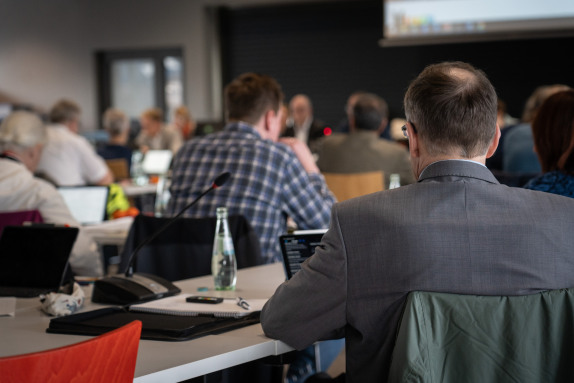
The meetings of the district committees are generally open to the public. Interested citizens can attend, obtain information and thus experience directly how municipal issues are discussed. The current meeting dates and agendas can be found in the council information system of the city of Bocholt.
According to § 3 of the main statutes of the city of Bocholt, the city area is divided into the following districts:
Map: Districts in Bocholt
A separate district committee is formed for each city district. This is based on § 39 GO NRW and § 3 of the main statutes of the city of Bocholt.
You can find an overview of the district committees on the interactive map:
How are the district committees made up?
Each district committee consists of 13 members - councillors and citizens with expertise.
-
The expert citizens must be eligible for election to the council and live in the respective borough.
-
Councillors on the district committee do not have to live in the borough.
-
At least two members must be city councillors, as only they can be elected as chairperson or deputy chairperson in accordance with Section 39 (4) No. 4 GO NRW.
The ratio of votes from the council election in the respective borough applies to the composition of the district committees. The committees may include more expert citizens than councillors.
Political groups that are not represented on a district committee may nominate a councillor or an expert citizen. These persons are appointed by the council and act in an advisorycapacity, but do not count towards the quorum.
Councillors who live in the borough or have stood for election there may also attend meetings in an advisory capacity.
Contact us

Gerlinde Visser
Sitzungsdienst und Internationales
Büro des Bürgermeisters und des Vorstands
Send e-mail
+49 2871 953-1284

Susan Bähring
Sitzungsdienst und Internationales
Büro des Bürgermeisters und des Vorstands
Send e-mail
+49 2871 953-1218
Felix Kuhmann
Sitzungsdienst und Internationales
Büro des Bürgermeisters und des Vorstands
Send e-mail
+49 2871 953-1285
Legal basis
- Hauptsatzung der Stadt Bocholt pdf 261,48 kB
- Hauptsatzung der Stadt Bocholt (pdf 261,48 kB) download
- Zuständigkeitsordnung für die Stadtverordnetenversammlung, die Ausschüsse und den Bürgermeister der Stadt Bocholt pdf 151,20 kB
- Zuständigkeitsordnung für die Stadtverordnetenversammlung, die Ausschüsse und den Bürgermeister der Stadt Bocholt (pdf 151,20 kB) download
- Geschäftsordnung für die Stadtverordnetenversammlung der Stadt Bocholt und ihre Ausschüsse pdf 217,80 kB
- Geschäftsordnung für die Stadtverordnetenversammlung der Stadt Bocholt und ihre Ausschüsse (pdf 217,80 kB) download