When clicking the language function, a connection with Google is established and your personal data is forwarded to Google!

Reset language

Job centre

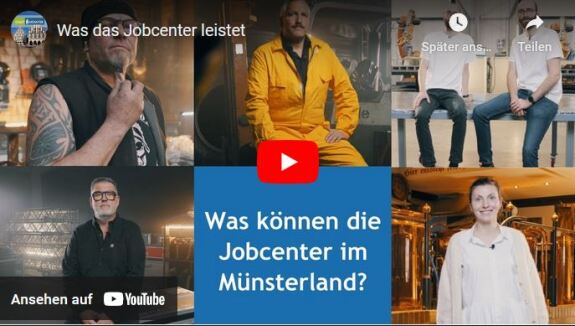
Video: What the Job Centre does

Click here to view the video.

Datenschutz-Hinweis: An dieser Stelle ist ein externes Video eingebettet. Wenn Sie dieses Video abrufen, können dabei Daten an Drittanbieter übertragen werden. Klicken Sie nur, wenn Sie damit einverstanden sind.

Click here to view the video.

The job centres in Münsterland provide more than just financial support in the form of citizens' benefits. They also serve as a point of contact for employers looking for suitable staff. They can counteract the shortage of skilled workers by providing customised placement and advice on funding opportunities.

Entrepreneurs from the region who are in contact with job centres in Münsterland to find staff have their say here.

And clear up prejudices.

Frequently asked questions about the application

What documents do I need to submit for a further authorisation application (WBA)?

In addition to the "WBA" form, current proof of assets must also be submitted. In any case, this includes bank statements for the last three months. If you have other assets (e.g. savings book, building society savings contract, life insurance, credit card, PayPal, ...) you should also submit current statements or proof of these.

In addition, you should submit the current consumption statement for heating and water costs, the current utility bill and your payslips, if you have not already done so, at the latest with your application for further education. As a general rule, you should inform the Job Centre of any changes to your living situation as soon as you become aware of them.

Can I also submit my documents digitally?

In addition to the letterbox and submission at the information desk, it is also possible to submit your application documents digitally. You can use the new contact form to upload your documents and send them directly to your contact person.

The contact form makes it easier to submit documents digitally and is technically more secure than sending them by e-mail.

Do I have to use up my savings before my application can be approved?

In principle, you do not have to use up all your savings.

There are allowances so that your assets are protected up to a certain limit:
Your saved assets are not taken into account during the waiting period in the first year of receiving the Citizen's Allowance up to an amount of 40,000 euros and 15,000 euros for each additional person.

After the waiting period, an allowance of 15,000 euros applies for each person. There are also protected assets, such as a reasonable car or a reasonably sized owner-occupied house or flat, which you do not have to use to overcome your need for assistance.

Details will be checked after the application has been submitted and can be requested from the Job Centre.

In the application documents, I am asked whether I produce my hot water decentrally. When is this the case?

If you have a decentralised hot water supply, you may be granted additional benefits for this. A decentralised hot water supply exists if the hot water is not produced centrally via the heating system, but separately, e.g. via an instantaneous water heater/under-sink appliance in your own home.

Billing is then usually done via the household energy. If this is the case, please state this in the application documents. If your hot water is supplied centrally, the hot water is always billed via the heating costs.

How long will it take for my application to be approved?

After you have submitted the initial contact, the application documents will be sent to you by your case officer. The processing time depends on how extensive your case is and how quickly you submit all the necessary application documents.

How do I know that my documents have been received?

If you submit the documents by e-mail, you will receive a confirmation e-mail stating that your e-mail has been received and is being processed. Documents that you drop in the letterbox or hand in at the information desk will be scanned and then forwarded to your contact person.

Once your application has been processed, you will receive notification by post. If we require further documents, you will also receive a letter from the Job Centre.

Frequently asked questions about housing costs and relocation

Which housing costs are taken into account?

Citizen's allowance and social assistance also cover the need for accommodation and heating. This applies both to the requirements for rented accommodation and for owner-occupied residential property.

The costs that are taken into account for rented accommodation include basic rent, ancillary costs and heating costs. In the case of owner-occupied residential property, debt interest and house charges can be taken into account. Repayment instalments are only taken into account in some exceptional cases.

In the first year of benefit receipt, the costs for accommodation are generally taken into account in full when calculating the benefit entitlement. Thereafter, if there are unreasonable costs, it is checked whether a change of residence would be economical. In this case, the unreasonable costs are recognised for as long as it is not possible or reasonable to reduce the costs, usually for a maximum of six months. Heating costs are only taken into account in the first year if they are reasonable.

Requirements for household electricity (except for heating) are part of the standard benefit.

When is a flat considered appropriate?

This overview shows guide values for what housing costs* are generally considered reasonable in Bocholt:

  • 1 person: 462.00 euros
  • 2 persons: 529.75 euros
  • 3 persons: 630.40 euros
  • 4 persons: 748.60 euros
  • 5 persons: 983.40 euros
  • each additional person: plus 134.10 euros

*Appropriate gross cold rent (basic rent plus cold ancillary costs), as of 6/2026

The job centre or social welfare office decides whether a flat is considered appropriate in individual cases, despite a higher gross rent. This may be the case, for example, in the event of a need for care.

What do I need to consider if I want to move?

If you receive citizen's allowance or social assistance and are planning to move house, the assumption of accommodation costs and the costs associated with the move must be reassessed.

If you want to ensure that the accommodation costs are covered in future, contact your responsible case officer in advance. They will advise you on the procedure for moving house.

I am moving into a new flat and have no furniture. Can the job centre subsidise this for me?

The job centre can grant an initial allowance for furniture if the relevant requirements are met. An informal application is sufficient for this. Details will be checked after the application has been submitted and can be requested from the Job Centre.

The initial furnishing includes lump sums for furniture and household goods. In individual cases, a replacement purchase can also be granted as a loan.

I have moved into a new flat and have to pay a rent deposit. Can the Job Centre pay the rent deposit?

The job centre can grant you a loan for the rent deposit if the requirements are met. Further details will be clarified in an interview.

You then repay the loan in instalments, which are deducted from your entitlement. The application can be made informally.

Frequently asked questions about loans and instalment payments

Can I get a loan in other situations as well?

In individual cases, an unavoidable unmet need may be granted as a loan, even if it is, in principle, covered by the standard allowance.

A need is considered unavoidable if it cannot be postponed in order to prevent an emergency situation (e.g. electricity bills in the face of an imminent disconnection). You should provide relevant evidence or explanations to demonstrate why your individual need is unavoidable and why a loan is therefore necessary.

I have received a letter from the Jobcentre informing me that I have to repay part of my benefits. I am unable to make this repayment in a single lump sum. What should I do?

Reimbursements for benefits already paid can also be repaid in instalments. Please speak to your benefits case worker or submit a proposal for repayment by instalments, stating the monthly instalments in which you wish to make the repayments.

Where possible, the instalments will then be deducted from your current benefit entitlement and paid directly until the total amount due has been repaid.

Other questions and information

Where can I find information about the Münsterland map?

If you're interested in education and participation in relation to the Münsterland Card, you'll find all the information you need on our dedicated page. (Click here.)

How can I be exempted from paying the broadcasting licence fee?

As a recipient of the Bürgergeld, you can apply for exemption from the obligation to pay the broadcasting licence fee. To do so, you can submit an application for exemption from the broadcasting licence fee to the Beitragsservice and provide proof that you are receiving the Bürgergeld.

Such proof is included in the initial approval notice and in every subsequent renewal notice from the Jobcentre. Please submit this certificate confirming your entitlement to benefits when you apply to the Beitragsservice.

I'd like to go on holiday. Do I need to discuss this with the Jobcentre?

Please make sure you inform your case manager if you are going on holiday or wish to leave Bocholt temporarily for any other reason. As a general rule, you will need the Jobcentre's permission to go away, as you will be out of contact during this time and therefore unable to be placed in a job.

Key terms - explained simply

Citizen's Income - Citizen's Income is a basic income or basic social security benefit for people who are able to work and in need. It replaces the former Unemployment Benefit II, also known as Hartz IV. Citizen's Income has been in place in Germany since 1 January 2023.

You are entitled to the Citizens' Income:

  • If in need
  • if you are fundamentally able to work
  • usually following Unemployment Benefit I

Needs - 'Needs' refers to the amount of money people require to live. This includes the cost of clothing, food and everything needed for daily living (including electricity). This amount is calculated and depends on age and family circumstances. At the Jobcentre, this is also referred to as "standard allowance"

Household - A household, also abbreviated to BG, is formed when several people from the same household apply for benefits (e.g. a family with children under the age of 25, spouses, registered partners or people in a stable relationship). At least one person must be fit for work. To ensure that not all members of the BG always have to attend in person to submit an application, a representative of the BG can be designated in writing to deal with specific matters. (See also: Household community)

Decision - When you submit an application for Bürgergeld to the Bocholt Jobcentre, you will receive a written response. This is also known as a decision notice. This notice contains, for example, information on how your application has been decided. In other words, whether it has been approved or not, whether there have been any changes, or whether you may have received benefits to which you were not entitled and need to repay some of the money.

Data protection - When applying for Bürgergeld at the Jobcentre, you will need to provide a lot of personal details. These are important so that the Bocholt Jobcentre can work out whether you are entitled to any money and, if so, how much. However, you can rest assured that your data will be handled by the Jobcentre in accordance with the regulations and is subject to special protection. There are regulations in place which the Bocholt Jobcentre adheres to strictly.

Income - Income is money that you receive on a regular basis (e.g. salary, interest, housing benefit, maintenance payments, child benefit, vocational training allowance or rental income). However, one-off payments, such as tax refunds, utility bill reimbursements or proceeds from sales, also count as income and must be declared.

Capacity for work - Capacity for work is the ability of any person over the age of 15 to work for at least 3 hours a day.

Household community - Unlike a 'needs community', members of a household community (also known as HG) live together but are not part of the same household. These include, for example, children over the age of 25, foster children, grandparents, uncles and aunts who live in the same household.

Need for assistance - You are considered to be in need of assistance by the Jobcentre and can therefore, in principle, apply for the citizen's income if you do not have enough money to live on, or if the money you earn is not sufficient to support the whole family. You are also considered to be in need of assistance if you are already receiving support from other social security providers (e.g. child supplement), but the money is still not enough.

Information - You will always receive a letter from the Bocholt Jobcentre whenever there are important changes affecting you. Please therefore read all letters carefully and ask for clarification if necessary. Your contact person's details are shown in the top right-hand corner of the letter.

Accommodation costs (KdU) - The Bocholt Jobcentre covers the costs of your accommodation and heating, provided these are reasonable. Your case worker will calculate this; you can also ask them about the current upper limits for rent or flat size. Even if you live in your own house or flat, the Jobcentre will calculate the costs accordingly.

Additional needs/special additional needs - Sometimes the standard allowance is not enough if you find yourself in special circumstances. You may therefore be able to apply for additional needs allowance. This is possible if you are pregnant (from the 13th week of pregnancy onwards), have a disability, rely on special dietary requirements, or, as a pupil, need to buy books prescribed by your school.

Furthermore, special additional needs apply where the cost of living is higher for specific reasons. These include, for example, special hygiene products required due to specific medical conditions or travel costs to visit your own child. Spectacles and dentures do not count as special needs!

Obligation to cooperate - Everyone receiving the citizen's income must cooperate with the Jobcentre. This is also known as the obligation to cooperate. You must therefore:

  • always provide accurate and complete information
  • be able to provide evidence to support your information, for example by presenting documents or certificates
  • notify the Jobcentre immediately if anything in your life changes that is relevant to your entitlement to benefits. For example, if you have found a job or your rent has increased.
  • submit a certificate of incapacity for work to the Jobcentre if you are currently on sick leave.

School pupils - As anyone over the age of 15 is considered to be of working age, young people from this age onwards are also invited to take part in the Bocholt Jobcentre's case management programme. The aim of the counselling here is, of course, to offer pupils the best possible support in their school career, in choosing an apprenticeship or in achieving other career goals.

Assets - If you apply for a citizen's income at the Bocholt Jobcentre, you must also declare your assets. These include, for example: bank balances, cars, motorbikes, life insurance policies, building society savings schemes, land, houses, flats, valuable jewellery or other valuable items.

Priority benefits - Before you can claim benefits under Book 2 of the Social Code, you must first check whether there are any other benefits that must be utilised first, known as "priority benefits%$. These include, for example, child benefit, child supplement, housing benefit, maintenance advance, pension, sickness benefit, parental allowance, BafÖg or unemployment benefit I.

Appeal - If you receive a letter containing a decision from the Bocholt Jobcentre with which you do not agree, you can lodge an appeal. You must submit your appeal in writing and state a reason why you do not agree with the Bocholt Jobcentre's decision.