


Jewish cemetery
Jewish cemetery Bocholt
בית החים (House of Life)
The Jewish cemetery on Vardingholter Straße is an important testimony to Jewish life in Bocholt. It was forcibly established in 1940 as a replacement for the older Jewish cemetery on the street "Auf der Recke". The reburial of the dead from the old Jewish cemetery took place under degrading circumstances: Polish prisoners of war were forced to carry out the work. This violated fundamental commandments of the Jewish religion - in particular the commandment of kwod hamet, כבוד המת respect for the deceased.
.webp?height=384&width=575 "image (1)")
In the Jewish faith, the cemetery is considered the "house of eternity"(בית עולם), a place of peace and sanctity. The dead should find their final resting place here - לזכרון עולם ינוחו בשלום על משכבם
In eternal memory - may they rest in peace in their resting place.
The integrity and permanent preservation of Jewish graves is a religious commandment and an expression of deep respect for life and death. Today, the Jewish cemetery not only commemorates the deceased members of the Jewish community, but also the history of persecution, destruction and new beginnings after the end.
History of the Jewish cemetery in Bocholt
Originally, there was a Jewish cemetery on the eastern wall of the town, which was established around 1700. This cemetery was relocated in 1810 due to health regulations. The new site was on the street "Auf der Recke", north of the water tower, and was in use until 1940. A list of names of Jewish deceased buried between 1822 and 1940, along with their dates of birth and death, can be viewed in the book "Three Jewish Cemeteries in Bocholt" by Werner Sundermann on pages 22 to 30 (see download link on the right-hand side).
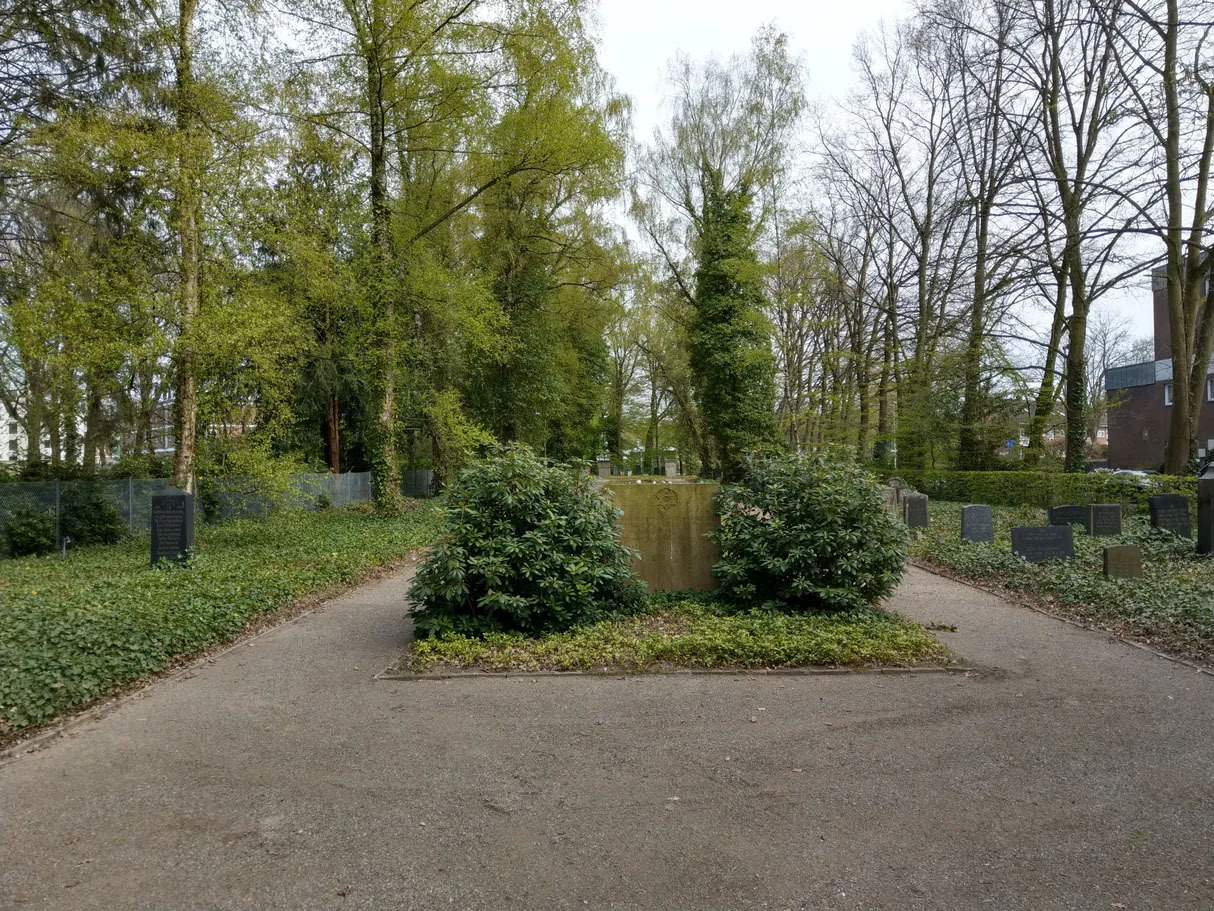
In June 1940, the Jewish Cultural Association of Bocholt was forced by the Nazi municipal administration to relinquish the cemetery on "Auf der Recke" and transfer ownership of the land to the town of Bocholt. As a replacement, a site on the outskirts of the town, in a small pine forest on Vardingholter Straße - directly on the border with the district of Stenern - was allocated.
The reburial of the deceased was carried out under duress. Polish prisoners of war from the nearby main camp (Stalag) VI F, colloquially known as the Stadtwaldlager, were forced to open the graves and exhume the remains. This was in flagrant violation of Jewish tradition, which commands the sanctity of graves and the inviolability of the dead's rest.
In total, at least 133 deceased were reinterred; 94 historical gravestones and 140 numbered stone markers were transferred to the new site.
A photographic and textual documentation of all existing monuments and numbered stones can be found in the book "Three Jewish Cemeteries in Bocholt" by Werner Sundermann from page 61 onwards (see download link on the right-hand side).
The reburial contradicts a central commandment of Judaism, which stipulates the inviolability of graves and the preservation of the peace of the dead. The new cemetery was designed as a woodland cemetery and was barely recognisable as such from the outside.
From the winter of 1943, Soviet prisoners of war from the nearby camp were buried in the still unoccupied burial plots - and even between the existing Jewish graves, contrary to Jewish burial tradition. This form of mixed burial fundamentally contradicts the Jewish understanding of the peace of the dead and the dignity of the Jewish cemetery as a sacred place exclusively for members of the Jewish community.
After the liberation from National Socialist rule, the city of Bocholt erected a memorial stone in May 1948 in memory of the Jewish citizens persecuted and murdered under National Socialism.
In 1964, the Jewish cemetery was extensively remodelled. The remains of the Soviet war dead were exhumed and transferred to the neighbouring Soviet war cemetery. The Jewish gravestones were re-erected and placed on cement plinths so that their inscriptions face east - in keeping with the Jewish tradition of facing Jerusalem. The memorial to the Jewish soldiers who died in the First World War, erected in 1925, was placed to the left of the entrance.
Sources and reference works on the subject:
Bocholter Quellen und Beiträge, Volume 3, Josef Niebuhr, Jews in Bocholt, Bocholt 1988
Bocholt Sources and Contributions, Volume 10, Werner Sundermann, Three Jewish Cemeteries in Bocholt, Bocholt 2002 (see download on the right-hand side)
Bocholt Sources and Contributions, Volume 13, Josef Niebuhr, Book of Remembrance. Jews in Bocholt 1937-1945, Bocholt 2013 (see download on the right-hand side)
Hans-Walter Schmuhl (ed.): Bocholt in the 20th Century: A Town on New Paths, Bocholt, 2022
Dr Wolfgang Buschfort, The Great Plunder. The Looting of the Jews in Bocholt, Bocholt 2026
Contact us

Further information
- Josef Niebur, Buch der Erinnerung. Juden in Bocholt 1937-1945, BQB Nr. 13, Bocholt 2013. pdf 9,82 MB
- Josef Niebur, Buch der Erinnerung. Juden in Bocholt 1937-1945, BQB Nr. 13, Bocholt 2013. (pdf 9,82 MB) download
- Friedhofsplan Jüdischer Friedhof pdf 3,41 MB
- Friedhofsplan Jüdischer Friedhof (pdf 3,41 MB) download
- Werner_Sundermann_Drei_jüdische_Friedhöfe_in_Bocholt pdf 66,80 MB
- Werner_Sundermann_Drei_jüdische_Friedhöfe_in_Bocholt (pdf 66,80 MB) download