


Flood in Bocholt in 1946
War destruction and flooding
© Stadtarchiv Bocholt, Nachlass Demes Nr. 24
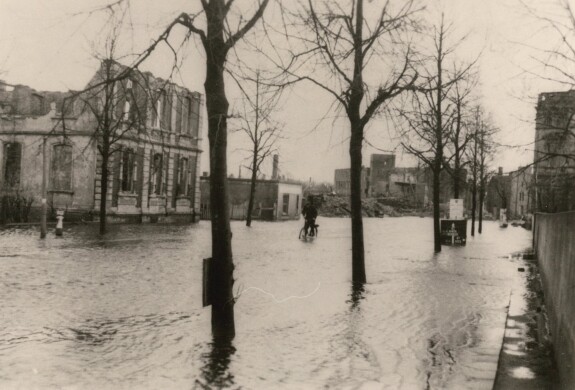
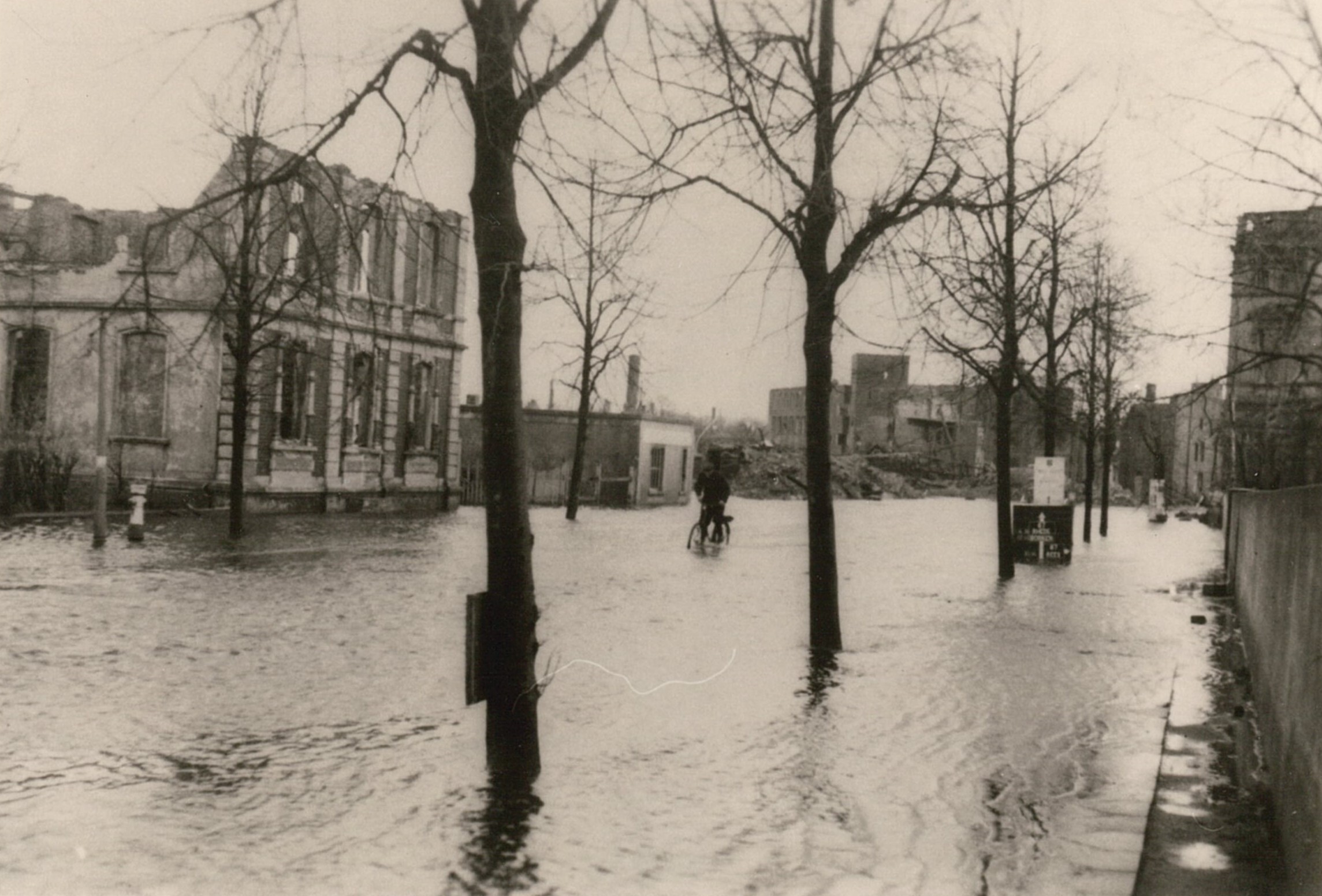
If you take a look at this photograph, the viewer will probably find it difficult at first glance to categorise what is depicted locally. To shed some light on the situation, the photographer is located in Dinxperloer Straße in the immediate vicinity of the Westendkreuzung intersection and is pointing his camera to the south.
From there, the ruins of the Marienlyzeum and the Capitol Theatre in front of it can be seen in the background. On the left are the ruins of the former building contractor Hülskamp's house and on the opposite side of the street are the remains of Villa Liebreich. The picture was taken in February 1946, when Bocholt was hit by a flood barely a year after the end of the war. The extent of this natural disaster is illustrated by the cyclist fighting his way through the flooded road.
In the first days of February 1946, 62 mm of rain fell over the city, and on 8 and 9 February alone, the local measuring station recorded 109.6 mm. It poured down in torrents without interruption. The low-lying areas in the borough were flooded early on. The heavy rainfall continued throughout the night of 9 February.
The city had already been hit by a devastating flood 20 years earlier, but unfortunately no photographs have survived.
Between rubble and flooded living space
This was a rude awakening for the population: Many of them had spent the winter in the cellars of their war-damaged houses, in garden sheds or in makeshift dwellings, but now they were also confronted with flooding. What they had previously saved from the bombs, the fire and the looting and had stored in the cellar as food and fuel, they now had to leave to the water. From the forest recreation area in the north to the railway, from Hochfeld and Fildeken to Mussum, everything was flooded, partly because the Aa was no longer able to drain off the masses of water due to debris obstacles.
According to estimates, the flood waters flowing through, including those that had already burst their banks, amounted to around 115 cubic metres per second - more than double the normal rate. Public life came to a standstill during these days, and the town council and the Borken military government launched an emergency aid programme to supply the population. From 13 February 1946, the flood waters gradually receded from the urban area.