


© Stadtarchiv Bocholt, Nachlass Halbfas Nr. 31
Construction work began in 1965 and the first residents moved in the following year.Town history: The stepped houses in the Löverick settlement
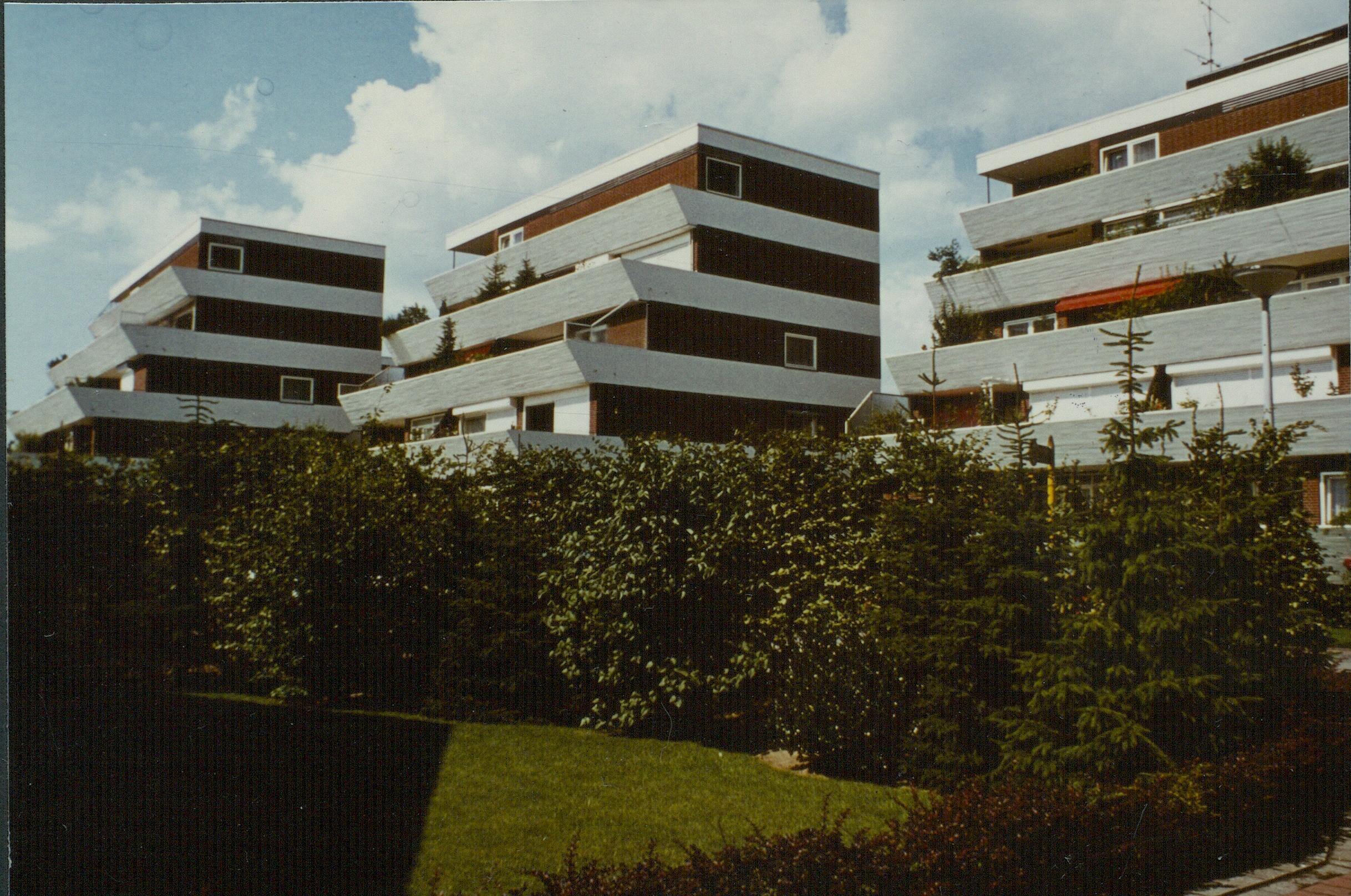
Photo of the month April of the city archive // Special construction method in the north of Bocholt
The "photo of the month" from the Bocholt city archive in April shows the stepped houses in the Löverick housing estate, which were built in Bocholt in the early 1960s.
After the devastating destruction of the war in March 1945, the town of Bocholt developed into a community that was very keen to build in the following decades. In addition to the necessary reconstruction of the town centre, the town planners also turned their attention to building housing estates throughout the area. From the end of the 1940s into the 1960s, the Heuting-Esch housing estate, with its continuation of the bungalow buildings on Erzengel, and the Giethorst and Hohe Giethorst development areas literally sprang up.
At the beginning of the 1960s, the Löverick housing estate with its school, community and business centre began to take shape. As building land was already quite scarce at the time, the municipal planning office, together with the Bocholt housing association, decided to build larger blocks of flats in the form of so-called stepped or hill houses in the north Löverick.
It was a bold move on the part of the investors to build these new blocks of flats designed by the Bocholt architect Bernhard Eimers. Construction work began in 1965 and the first residents moved in the following year. In total, seven of these terraced buildings were built on Richterstrasse, with a total of 56 different freehold flats on 678 square metres of living space per block.
They each comprised five storeys, tapering upwards with steps. The individual residential units consisted of two-, two three-, four- and five-room flats with an additional garage for each household. The construction costs depended on the size of the individual flats and at the time were between DM 40,600 and DM 69,650.
With the realisation of this housing estate project on a total area of 10,650 square metres, the city planners took into account the plan for concentrated living by saving building land, which made it cheaper to install the supply lines and allowed green spaces to be densified. By the time the topping-out ceremony for the stepped houses was celebrated in April 1966, all of the flats had already found their owners.
Photo: Bocholt city archive, Halbfas estate no. 31 / Text: Wolfgang Tembrink
© Stadtarchiv Bocholt, Nachlass Halbfas Nr. 31
Construction work began in 1965 and the first residents moved in the following year.