


Living in municipal accommodation
The town of Bocholt follows a clear approach to the accommodation and integration of refugees. This approach is divided into three stages, designed to help you gradually build an independent life:
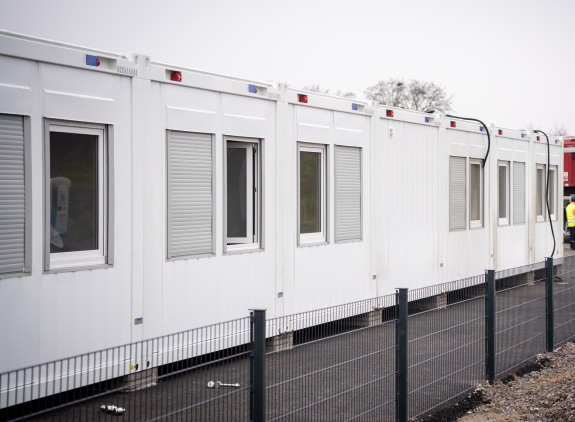
Stage 1 - Supported initial accommodation: Upon your arrival in Bocholt, you will first move into a larger initial accommodation facility (e.g. at Takenkamp). Here, you will receive intensive support as you settle in. Social support services will help you with the very first administrative and practical steps in the town.
Stage 2 - Supported off-site accommodation: In the second phase, you will leave the large initial accommodation. You will move into a flat or a shared flat (WG) that has been let by the City of Bocholt for this purpose. Here, too, the social support team will continue to assist you with any queries.
Stage 3 - Independent living: In the final stage, you will search for and rent a private flat on the open housing market independently. You will sign your own tenancy agreement and live completely independently. From this point onwards, the social support service will no longer be responsible for you. If you have any questions about life in the neighbourhood, you can contact the local neighbourhood offices. Further information is available at bocholt.de/quartiere.
Important: The accommodation in stages 1 and 2 is emergency accommodation provided by the City of Bocholt. These properties have everything you need for day-to-day life. Use of this accommodation is not free of charge; fees apply.
Note on the asylum procedure: Whilst your asylum procedure is still ongoing, you will usually have to live in municipal accommodation (Step 1 or 2). Would you still like to rent a private flat yourself? Please make sure you speak to the Immigration Authority and the Social Services Department beforehand!
Facilities

© Stadt Bocholt
In the municipal accommodation (Levels 1 and 2), the City of Bocholt provides you with a basic set of essentials. If you are travelling alone, your room will include:
-
A bed with a mattress
-
A wardrobe
-
A table and a chair
You will share the kitchen, bathroom and toilets with the other residents on your floor or in your flat. A washing machine is also available for use.
Rules regarding furnishings: All furniture provided is the property of the City of Bocholt. You are not permitted to bring your own large items of furniture into the accommodation or to dispose of the existing furniture. When you move out, all furniture must remain in the accommodation, complete and undamaged. Families or shared flats will be provided with a correspondingly larger range of furnishings, tailored to their needs.
If you move out of the council accommodation (e.g. into your own flat), you must follow these steps:
-
Clean your room and the communal areas you have used thoroughly (swept and clean).
-
Take all your personal belongings with you.
- Hand over all keys you have been given in full to the accommodation management or social services.
Important for your finances: Only once the room has been properly handed over can the accommodation management or social services officially deregister or re-register you with the City of Bocholt. Until this official deregistration or change of address has taken place, the accommodation fees will continue to accrue and must be paid by you!
Rules for living together (house rules)
Compulsory attendance
Visitors and night-time quiet hours
Cleanliness, waste sorting and ventilation
Use of the washing machines
Safety, fire safety and prohibitions
Saving energy and reducing heating costs
Parental duty of care & liability for damage
Consequences of breaching the rules
Social care in Bocholt
The staff at the Social Services department work on behalf of the City of Bocholt. They are on hand to help you with any day-to-day queries, problems or administrative matters.
You can simply drop in during the weekly consultation hours without needing to book an appointment in advance (open consultation hours).
Address of the social services department: EWIBO GmbH; Theodor-Heuss-Ring 23, 46395 Bocholt
Please refer to the notice displayed at Theodor-Heuss-Ring 23, 46395 Bocholt for the consultation hours (no appointment required).
Cleaning, Hygiene & Outdoor Areas

© mit KI generiert
Who is responsible for cleaning what in the accommodation?
-
Your own room: You are solely responsible for the cleanliness and hygiene of your own room. You must sweep, mop and keep it clean on a regular basis.
-
Communal areas: As the kitchen, bathrooms and toilets are shared by several people, cleaning rota charts are displayed there. This means that the cleaning of these areas is shared on a rota basis amongst the residents. Please stick strictly to your allocated cleaning days.
-
Corridors and basement areas: You will find the rota for the communal areas on the noticeboard at the accommodation. This specifies who is responsible for cleaning the hallway, the stairwell, the bicycle storage room or the laundry room, and when.
Outdoor tasks
Residents must also take turns carrying out tasks around the building to ensure it looks tidy and remains safe:
-
The pavements, access paths and courtyard areas in front of the building must be swept regularly and kept free of weeds.
-
Winter maintenance: When it snows in winter or the paths become icy, the pavements must be cleared and, if necessary, gritted so that passers-by and residents do not slip and injure themselves.
-
Garden maintenance: If your accommodation includes a garden, this must be maintained collectively. The necessary gardening tools will be provided for this purpose. Tasks include, for example, weeding, raking up leaves and sweeping the garden paths.
Important note regarding drainage pipes: Never pour food scraps, cooking oil or used fat down the sink, into the shower or down the toilet! Fat hardens in the pipes and very quickly leads to stubborn blockages. This can cause serious water damage and flooding in the flat. Please dispose of all food scraps and fats exclusively in the normal household waste (residual waste).
Good Neighbourliness
Living peacefully and respectfully with your neighbours - both in your accommodation and in the wider neighbourhood - is the foundation for settling in well within the community. Please note the following:
-
Follow the house rules: Always adhere to the agreed rules. If anything is unclear or you encounter any problems, the social support team will be happy to mediate on your behalf.
-
Avoid noise: Avoid making loud noises in your flat. Pay particular attention to the statutory quiet hours (on weekdays from 10.00 pm to 6.00 am, and all day on Sundays and public holidays).
-
Give notice of parties: If you are planning a private party that might get a bit noisy, it is good practice to inform your neighbours in a friendly manner a few days in advance.
-
Keep escape routes in the stairwell clear: The stairwell and corridors serve as escape routes in an emergency (e.g. in the event of a fire). It is therefore not permitted to leave personal items such as bicycles, pushchairs, shoe racks or large numbers of shoes there on a permanent basis. These routes must be completely clear and accessible to everyone at all times.
Address problems directly and calmly: Should a misunderstanding or dispute with a neighbour ever arise, seek a calm and polite conversation with the person concerned. A friendly discussion usually resolves most situations quickly. If no agreement can be reached, ask your social support team for assistance.
Renting private accommodation
Once you hold an official residence permit (following a successful outcome to your asylum application), you have the right to look for and rent your own private flat on the open housing market.
Strict procedure to follow if the Jobcentre is paying the rent: If you are receiving financial support (basic income support) and the Jobcentre is to cover the costs of your new flat, you must strictly follow the procedure below. Never sign a tenancy agreement prematurely!
-
Looking for a flat: Look for a suitable flat that meets the Jobcentre's guidelines (reasonable size and rent).
-
Submit a tenancy offer: Ask the landlord for a written tenancy offer (or a draft tenancy agreement) and submit this to the Jobcentre in advance for review.
-
Wait for approval: The Jobcentre will check whether the costs for the flat are permissible and issue you with written confirmation (approval).
-
Sign the tenancy agreement: You may only sign the tenancy agreement in a legally valid manner once you have received the Jobcentre's written "approval"!
If you sign the tenancy agreement before receiving official approval, in most cases you will have to pay the rent and the deposit in full yourself, which can lead to significant debt.
Guide to Living in Bocholt: Information and Guidance
The tenancy deposit
Pets in the flat
Tips for finding a flat
Support after moving house: The neighbourhood offices
Rules and obligations when moving house
A distinction is made between two types of relocation, each of which is subject to important legal rules:
Moving to another council-provided accommodation
For organisational reasons, the City of Bocholt may relocate you to another shared accommodation facility. In this case, you will receive written notification from the City or your social services team.
-
Important obligation following this: You must go in person to the Citizens' Office in the town hall within 14 days of the move to have your new address officially recorded on your identity documents (statutory obligation to register).
Moving into your own private flat
If you have found a flat yourself, please inform your social services team immediately so that the next administrative steps can be taken. If you are receiving financial assistance, the following also applies here: do not sign the tenancy agreement until the relevant authority has approved the costs in writing.
Checklist for moving day:
-
Thorough cleaning: Leave your old room in the council accommodation completely clean and tidy.
-
Handover inspection: A member of staff from EWIBO GmbH will inspect the room with you for any damage and draw up a handover report.
-
Returning keys: Hand back all the keys you received for your old accommodation.
- Changing your address at the town hall: Within two weeks, visit the Citizens' Office (Residents' Registration Office) at the town hall to officially register your new address. Please bring the landlord's confirmation (landlord's certificate), signed by your landlord. Please book a personal appointment online in advance at bocholt.de/buergerbuero to change your registration.
Important - Make sure you actively notify others of your new address! After you move out, the social services department will forward your post to your new private address for a maximum of four weeks. After that, letters marked "address unknown" will be returned to the senders. You are legally obliged to notify all relevant authorities of your new address immediately and on your own initiative:
-
Public authorities and offices: Citizens' Advice Bureau (Residents' Registration Office), Jobcentre, Social Services Department (Social Welfare Office), Immigration Office, Jobcentre, Tax Office, Family Benefits Office (child benefit) and, where applicable, the Vehicle Registration Office (if you own a car).
-
For your asylum proceedings: The Federal Office for Migration and Refugees (BAMF). Please send your change of address by post to: BAMF, Alleestr. 165, 44793 Bochum, or by email to: service(at)bamf.bund(dot)de.
-
Children and family: Your children's schools, nurseries and sports clubs.
-
Work: Your employer (HR department).
-
Day-to-day life and contracts: Your health insurance provider, your bank or savings bank, your GP and specialist doctors, insurance companies, mobile phone and internet providers, and the broadcasting licence fee (GEZ).
Changing your registered address and new contracts (detailed guide)
Moving into a private flat requires you to sort out your contracts yourself. As the terminology used in the German registration system is often complex, you'll find the most important steps clearly summarised here:
Step 1: The Citizens' Advice Bureau and the landlord's confirmation
You must re-register at the Residents' Registration Office within 14 days of actually moving in. To do this, you must have what is known as a 'landlord's confirmation'. This is an official document that must be signed by your new landlord. You can download the document from bocholt.de/serviceverzeichnis/bescheinigung-wohnungsgeber. It confirms to the registration authority that you have actually moved into this address. Without this document, the Residents' Registration Office cannot register your new address in the system. It is best to book an appointment online in advance for your visit to the Citizens' Office at bocholt.de/buergerbuero.
Step 2: Nameplate on the letterbox
On the day you move in, attach a clearly legible nameplate bearing your surname to your new letterbox and doorbell. In Germany, postmen will only deliver letters if the name on the letterbox matches the address on the envelope exactly. If your name is missing, important post from government departments, courts or health insurance companies will be returned to the sender immediately, which could have significant legal consequences for you.
Step 3: Registering for electricity and gas yourself
In Germany, the costs for personal electricity consumption and often also for gas (heating/hot water) are usually not included in the service charges for your rent. This means that, immediately after moving in, you must register with an energy supplier (e.g. stadtwerker GmbH or another provider) yourself.
-
On the day you collect the keys, check the current electricity and gas meter readings together with your landlord and make a note of the meter numbers.
-
Using this information, you can take out your own supply contract. You will then pay a fixed monthly instalment to the energy company. At the end of the year, you will receive a final bill: if you have used less, you will receive a refund; if you have used more, you will need to pay the difference.
-
Tip: Compare energy prices and contract terms online to save money.
Damage to the accommodation
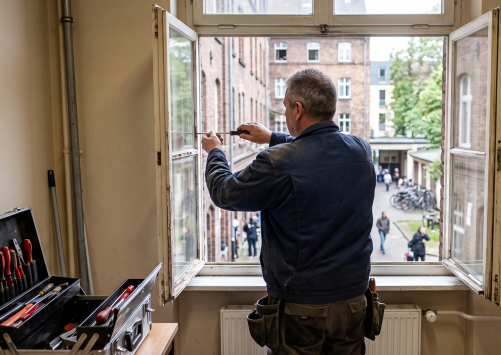
Has something broken in your flat? Please follow these guidelines:
Minor damage (during office hours): Please report the damage to Social Services. You can do this from Monday to Friday between 08:00 and 16:30. The main telephone number is 02871 21765-0.
Important: Please take a photo of the damage. Send the photo along with your message to Social Services.
What can you do yourself? You can and must repair or clean minor issues yourself. For example: replacing a burnt-out light bulb with a new one or cleaning the filter (lint trap) in the washing machine.
Who carries out major repairs? For all other repairs, the caretakers or companies sent by EWIBO GmbH are responsible. Do not pay any external companies yourself!
Emergencies outside office hours (at night and at weekends): In the event of a genuine emergency (such as a major burst water pipe or a heating failure in winter), call the caretakers' emergency number: 0152/32175081
Saving energy: Heating and ventilation
By using your heating and ventilation systems responsibly, you can help protect the environment and save a lot of money on your utility bills. The Consumer Advice Centre provides detailed information leaflets on this topic in many different languages at verbraucherzentrale.de/fluechtlingshilfe.
Heating Properly
Proper Ventilation
Washing and drying laundry
Waste sorting and waste disposal
In Germany, everyone is legally obliged to sort their waste carefully. Sorting waste correctly protects the environment and enables the recycling of raw materials.
Important: If bin bins are filled incorrectly (e.g. plastic in the paper bin), the refuse collection service will refuse to empty the bin. You will then have to laboriously sort the rubbish by hand.