


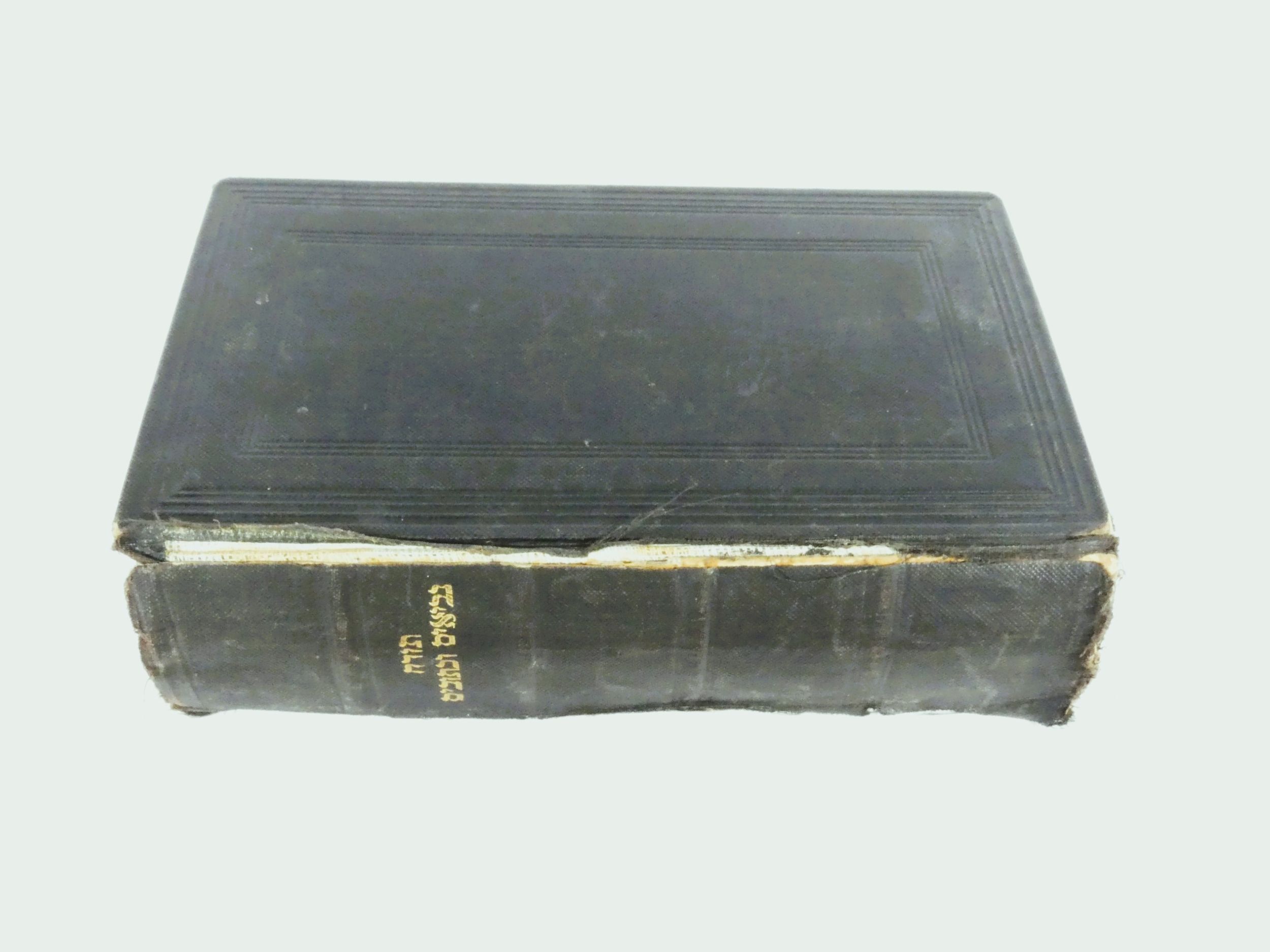
© Stadtmuseum Bocholt, Inventarnummer: 2023.428
The Tanakh (often spelt Tanakh) is the Hebrew Bible of the Jews.Tanakh is object of the month November 2025
Tanakh from the first half of the 20th century // Centrepiece of the Jewish faith // Exhibition in the LernWerk, 1st floor // Object and photo of the month on display in front of the event hall
The Tanakh, the Hebrew Bible and the central text of Judaism, is the Bocholt City Museum's object of the month in November. The copy from the first half of the 20th century is on display together with the photo of the month in the LernWerk on the first floor. The presentation provides an insight into the history, significance and tradition of this formative work of literature.
The Tanakh (often spelt Tanakh) is the Hebrew Bible of the Jews. The copy shown here dates from the first half of the 20th century. The name Tanakh is an acronym of the three parts Torah (instructions), Nevi'im (prophets) and Ketuvim (writings). The original Hebrew version of the Tanakh is also called "Mikra" in Hebrew. This name means "the called", because reading the Word of God is like calling out to God.
The Tanakh teaches faith in the only God who has made a covenant with Israel. This covenant demands justice, faithfulness and love of neighbour. Through the Torah, God shows how people should live properly. The prophets repeatedly call for repentance and proclaim hope in times of suffering. Despite everything, the confidence remains that God is faithful and brings redemption. The Jewish canon comprises 24 books. Its three-part structure developed gradually and was well established by the end of the 1st century BC at the latest. The texts of the Tanakh were written over a long period of time, roughly from the 10th to the 2nd century BC. It tells the story of creation and the people of Israel. Christianity has adopted all the books of the Tanakh, in a slightly different order, as the Old Testament. The Tanakh exists in various forms. Traditionally, the Torah is written by hand on parchment scrolls. Today, the Tanakh is also available in printed book form. It contains the same text, but is not available for liturgical use in synagogues.
The Tanakh is therefore not only a historical document, but also the centrepiece of the Jewish faith. To this day, it conveys ethical principles, hope and orientation in life. Its stories, laws and instructions characterise the religious thinking, rituals and communal life of Jews. The Tanakh has also had a great influence beyond Judaism, for example on Christianity and Western culture, and remains a timeless testimony to the relationship between God and man.
Text: Maja Fahrland, Photo: Stadtmuseum Bocholt, Inventory number: 2023.428, Owner: Stadtmuseum Bocholt
© Stadtmuseum Bocholt, Inventarnummer: 2023.428
The Tanakh (often spelt Tanakh) is the Hebrew Bible of the Jews.