


© Stadt Bocholt
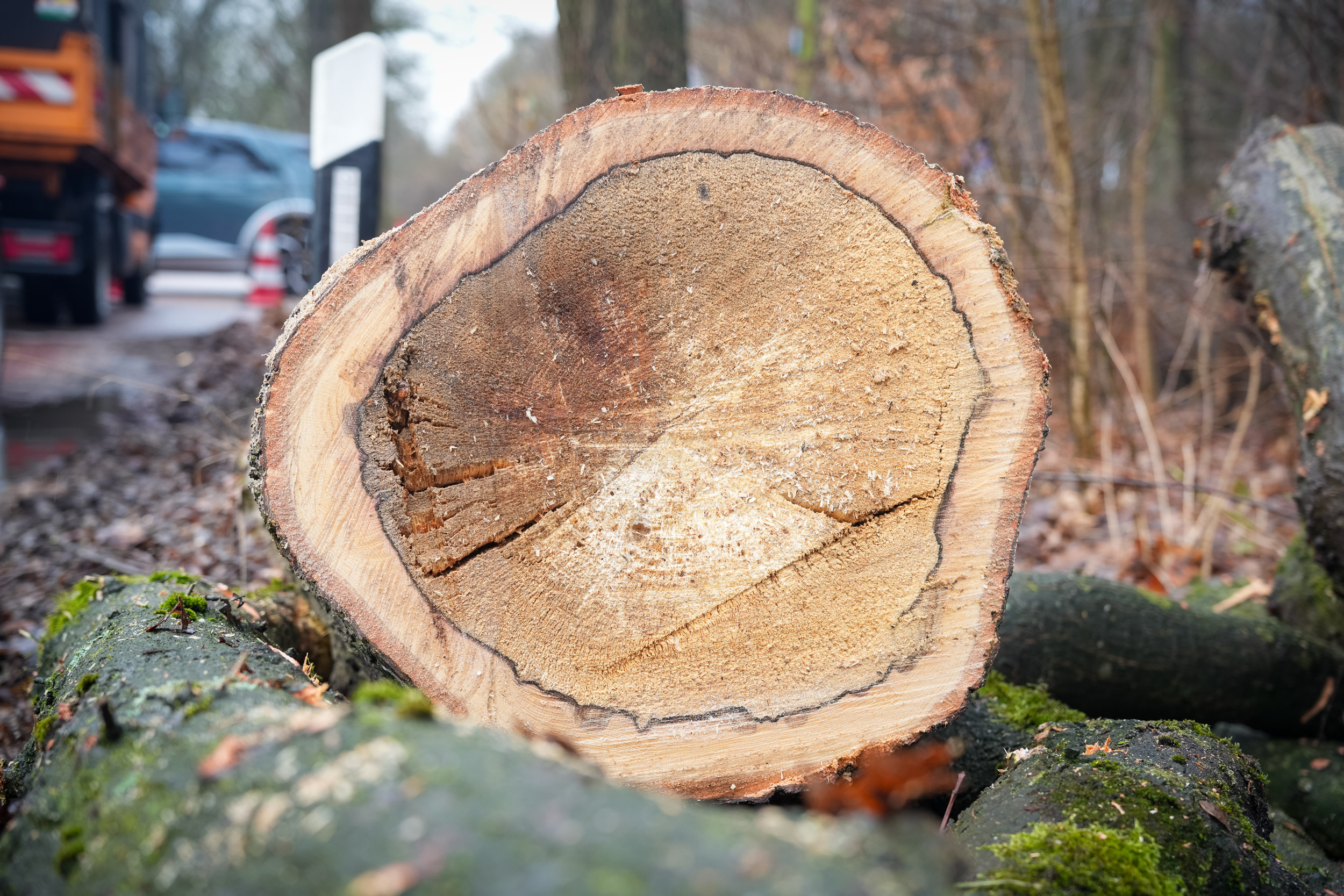
A look at the cut surface of a felled red oak shows the destructive effect of white rot. The dark, ring-shaped barrier zone, with which the tree tried in vain to stop the advance of the white rot and protect healthy wood tissue, is clearly recognisable.Fungal infestation: tree felling started in Ziegelheide
Fungal infestation by lacquer fungus makes felling unavoidable // Stability jeopardised
Today, Tuesday, the city of Bocholt began with necessary tree felling in the city forest. Ten red oaks that have been severely weakened by fungi must be removed by the waste disposal and service company for safety reasons in order to ensure safety in public spaces.
Work began today, Tuesday 17 February, in the area of the streets Am Ziegelofen and In der Ziegelheide. As part of the regular tree inspections, the experts noticed a significant weakening in a total of ten red oaks, which is due to a fungal disease.
In order to be able to make a reliable statement about the condition of the trees, detailed investigations were carried out in advance using bore resistance measurements. These measurements confirmed the experts' fears: the remaining wall thickness of the trunks no longer fulfils a sufficient static function, which directly endangers the stability of the affected trees.
The city of Bocholt emphasises that the removal of these trees is unavoidable in order to guarantee the general safety of the path and to rule out any danger to passers-by and moving traffic.
The reason for the poor condition of the oaks is the infestation by wood-destroying fungi such as the lacquer fungus. This fungus causes so-called white rot inside the trunk, which breaks down both lignin and cellulose. This causes the wood to rot. Such fungal infections occur more frequently in trees that are already weakened by complex external circumstances, such as prolonged drought or difficult climatic conditions. The effects of the infestation can be clearly recognised on the trunks that have already been felled: The wood is largely rotten in the core area. A dark barrier zone is also visible, with which the tree attempted to limit the spread of the fungus.
Following these urgent safety measures, further scheduled forest maintenance measures will be carried out in the entire area of the municipal forest from mid-March. This work will focus primarily on the areas along the paths and squares in order to ensure long-term road safety.
Around 250 individual trees of various species, including oaks, beeches and pines, will be removed as part of this work. In addition, the thinning of a contiguous poplar stand is planned in order to provide the remaining trees with better growing conditions and to sustainably strengthen the forest.
© Stadt Bocholt
A look at the cut surface of a felled red oak shows the destructive effect of white rot. The dark, ring-shaped barrier zone, with which the tree tried in vain to stop the advance of the white rot and protect healthy wood tissue, is clearly recognisable.