


©
© Stadt Bocholt
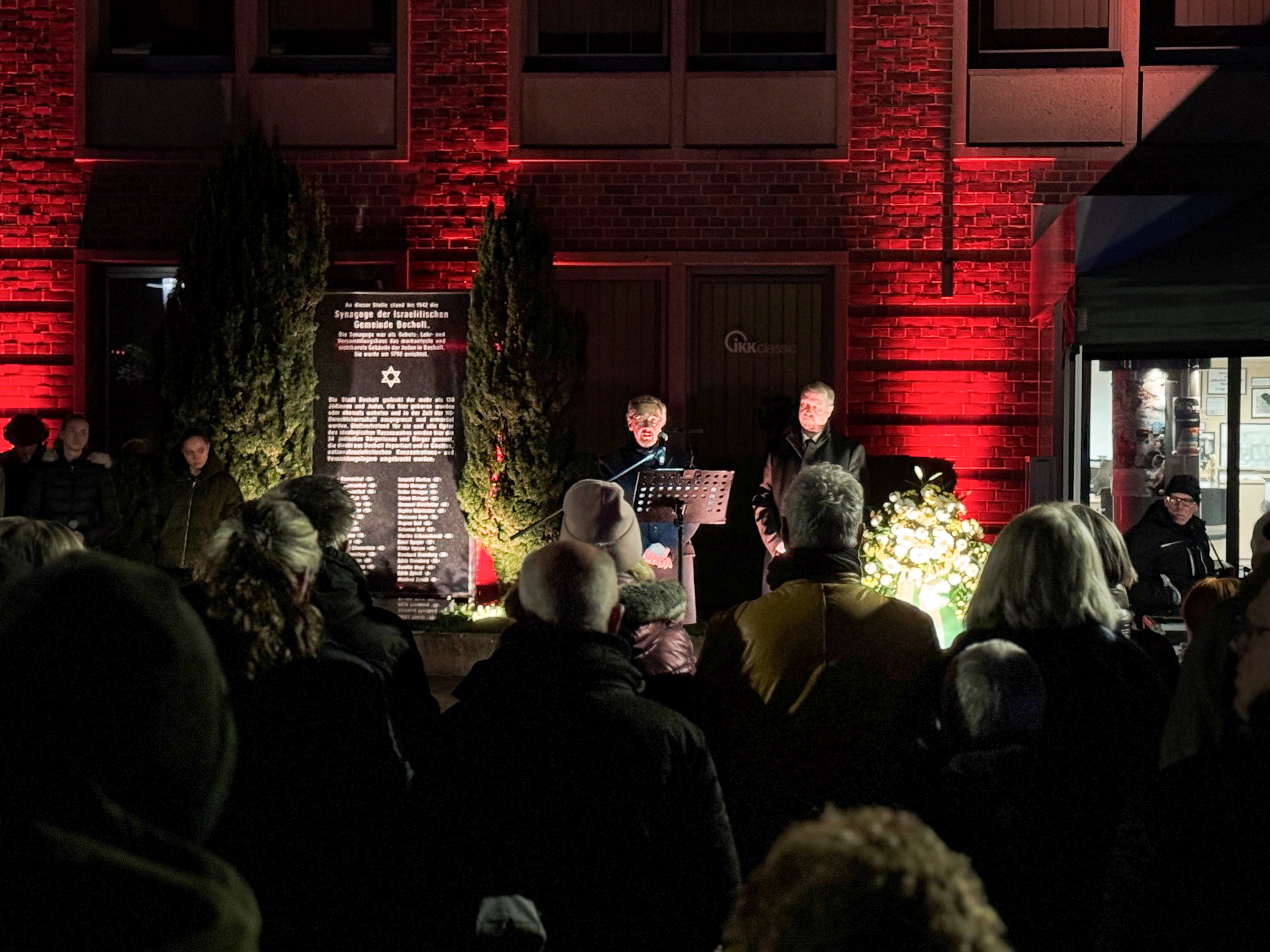
A moment of silence at the memorial to the desecrated synagogueBocholt commemorates the victims of Kristallnacht
A silent tribute at the memorial to the desecrated synagogue // Deputy Mayor Björn Volmering stands in for the mayor, who is unwell // Pupils from the Mariengymnasium read accounts from eyewitnesses // Tribute to the late local historian
On Monday evening, the town of Bocholt held a silent commemoration to honour the victims of Kristallnacht 88 years ago. The commemorative address at the memorial site of the desecrated synagogue, in front of the Haus des Handwerks, was delivered by First Councillor Björn Volmering. He stood in for the mayor, Christian Mangen, who was unwell. Pupils from the Mariengymnasium organised the commemoration with spoken contributions and music, in collaboration with the City of Bocholt's Department of Culture and Education.
On the evening of 9 November, local residents, visitors and pupils from the Mariengymnasium gathered at the site where the Bocholt synagogue once stood. During the night of 9 to 10 November 1938, National Socialists from Bocholt had destroyed its interior. Following a particularly atmospheric and dignified musical introduction by the pupils of the Mariengymnasium, Björn Volmering, Deputy Mayor and Head of the Culture Department, thanked those present for attending. He expressed special thanks to the young people and their teachers for preparing and organising the commemoration. The Mariengymnasium has entered into an educational partnership with the town on the culture of remembrance and has been helping to organise the commemoration on 9 November for many years.
Before the actual commemoration, Volmering paid tribute to the local historian Josef Niebur, who passed away on 28 August. For decades, Niebur researched the fates of Bocholt's Jewish community and played a key role in the redesign of the memorial site. To this day, the local authority, schools and the community draw on his work when addressing the crimes committed by the Nazis in Bocholt. "Without his work and his commitment, neither today's event nor the memorial site behind me would have been possible in this form", said Volmering. Among other honours, Niebur was awarded the Federal Cross of Merit on Ribbon, the City's Silver Medal and the Badge of Honour from the German-Israeli Society. Those present observed a moment's silence in his memory.
"What happened here is not right"
The pupils recounted what happened that night in Bocholt, drawing on the memories of eyewitnesses. On the morning after the pogrom, Fritz Duesing cycled to his apprenticeship in Rhede. At Villa Liebreich in Westend, he saw the devastation through the open front door. At the synagogue, he found smashed windows, destroyed benches and torn prayer books. The curtain of the Torah ark and the Torah scrolls lay on the floor. Duesing thought at the time: "What has happened here is not right."
That night, almost all the homes and shops belonging to the Jewish residents of Bocholt were destroyed, alongside the synagogue. The Cohen family on Dingdener Straße were also affected. An eyewitness recalled how Sally Cohen was dragged across the street in his pyjamas and beaten. He and his wife Juliane fled to Amsterdam in 1939. Following the German occupation of the Netherlands, they were deported to Auschwitz. Sally Cohen was murdered there in 1944; Juliane Cohen died in 1945 as a result of her imprisonment. According to Volmering, their fate is representative of the stories of many Jewish men and women who fled between Bocholt and the Netherlands.
The young people then read an extract from the speech given by Holocaust survivor Tova Friedman. She had spoken in the German Bundestag on 28 January 2026 to mark International Holocaust Remembrance Day. Friedman is one of the few survivors who can still bear witness in person. "History has shown us that forgetting is never neutral - it is dangerous", she said in her speech.
Those present then observed a moment's silence in memory of the victims of the pogrom. They also paid tribute to the more than 190 residents of Bocholt who were murdered simply because they were Jewish. Reverend Axel Gehrmann said a prayer. This was followed by a clarinet solo from the film score of "Schindler's List%$. The pupils also read out words from North Rhine-Westphalia's Minister-President Hendrik Wüst. He had spoken these words on 20 May 2026 during a visit to the Auschwitz-Birkenau Memorial: "Remembrance is not a ritual of the past, but a mission for the present."
"Never look away again"
In his closing address, Volmering said that Kristallnacht took place 88 years ago - roughly a human lifetime. Right now, he said, many people are frightened by political developments in Germany. Because both far-right and far-left forces were growing stronger, commemorating the crimes committed - including those in Bocholt - must be a mission and must not become a mere ritual. Much of what had been painstakingly achieved and acknowledged over the past decades was now being publicly called into question by certain political forces.
"In our good, strong and convincing democracy, we really have nothing to fear. We must not fear diversity, but rather narrow-mindedness", said Volmering. "'Never again!' means not only never again desecrated places of worship, but also: never again looking the other way. Never again remaining silent. Never again going along with it." He asked those present to consider for themselves where their own contribution lies, or could lie.
Film screening at the Kinodrom
This year's commemoration also includes a film. The city of Bocholt invites you to the Kinodrom, Meckenemstraße 8, today, Tuesday 10 November, at 8.00 pm. The drama "Never Alone" will be screened. It is based on true events and tells the story of the Jewish businessman Abraham Stiller, who offered shelter to Jewish refugees in Finland during the Second World War. Admission is free.
For the speech by First Councillor Björn Volmering and the programme
©
© Stadt Bocholt
A moment of silence at the memorial to the desecrated synagogue