


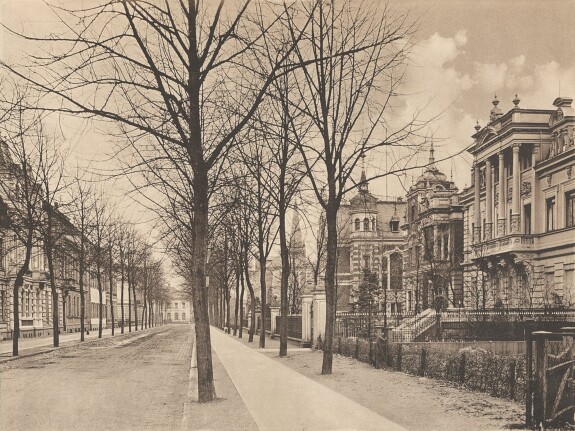
A view of Bahnhofstraße in 1915
© Stadtarchiv Bocholt, Bildsammlung Nr. 523
Blick in die Bahnhofstraße um 1915In 1878, the town of Bocholt was connected to the railway network leading to Wesel, which had been built by the Cologne-Minden Railway Company.
The first station building was erected a short distance south of the former shooting club. The name "Bahnhofstraße", given to the new access road to the railway site laid out in 1881, was a natural consequence.
An eventful history
The viewer is standing at the eastern end of Bahnhofstraße and, in this autumnal scene dating from around 1915, is looking westwards from the station.
The magnificent manufacturers' houses on the northern side of the street, built in the 1880s and 1890s in the Historicist style, catch the eye. On the far right, the villa of the Jewish merchant Emil Cohen comes into view; it was purchased by the town of Bocholt in 1927 and has served as the mayor's official residence ever since. From 1936 onwards, the Nazis used the building as headquarters for the local Hitler Youth. Destroyed by bombing in 1945, the ruins were cleared in 1960 and the site has not been redeveloped to date.
The house next door belonged to the Jewish manufacturer Iwan Magnus. The villa next to it was built by the manufacturer Heinrich Budenberg, who sold it to the Jewish industrialist Max Cohen in 1909. Behind the other residential buildings stands the tower of St Joseph's Church.
Public opposition to tree felling
In contrast to the right-hand side, the left-hand side of the street is lined with just a single row of trees. The buildings lining the street were also predominantly home to merchants from Bocholt's upper class. Whilst their houses likewise convey a noble and spacious impression, they are nowhere near on a par with the feudal villas opposite.
On 13 December 1904, the town councillors decided to have the northern row of trees felled. However, this led to a "fierce protest%$ from the residents of Bahnhofstraße, as the local daily newspaper put it at the time. In the end, the council's decision was not implemented, so the citizens could continue to take pride in their - to quote the newspaper - "'only avenue'% $.