


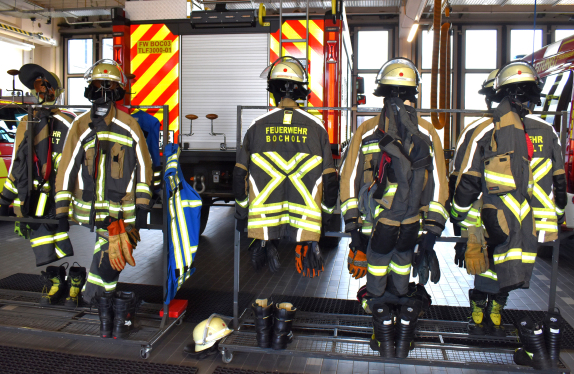
Volunteer Fire Brigade
A role that gives you a lot
Helping others. Volunteering, just because. Who on earth does that sort of thing? The men and women of the volunteer fire brigade do just that, and they're there for everyone - even for those who ask such thoughtless questions. But above all, they're there for the many grateful people who appreciate what they do. Community spirit would be completely lost without those who dedicate themselves to it - out of conviction, compassion and empathy. Just because. They are doing something important, valuable and meaningful. And not least for that reason, it is also something that brings them personal fulfilment.
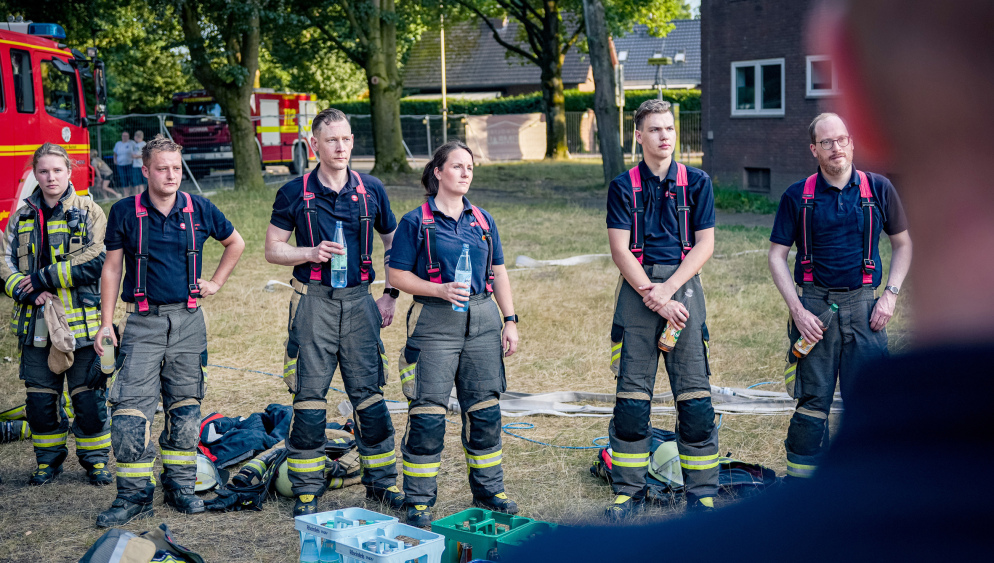
Yes, the effort involved is considerable. And yes, you have to take certain restrictions into account. To begin with, working in the operations department naturally requires training, which takes place at weekends. It lasts for at least half a year. Further courses may follow. As is well known, the fire service isn't only called out to fight fires. More common are so-called technical rescue operations, such as at road traffic accidents, during power cuts, or in the event of storms and heavy rain. 112 is the number to call in almost all such cases. In this respect, there are few predictable emergencies for firefighters, but plenty of variety and much to learn.
© Stadt Bocholt
Inspiring from an early age
There's something appealing about learning and practising as part of a team. Technical knowledge and the craft skills you acquire or develop are of personal benefit beyond their application within the fire service. The same applies to the teamwork and collaboration you practise. It's also great fun when you're with friendly, like-minded people. Many people appreciate the physical challenge. And, as an added bonus, it doesn't hurt to equip yourself with stress management skills.
The fire service - it appeals to children right from the start. Initially, it's associated with the "Tatü-Tata" sound, signalling that something exciting is happening. Emergency vehicles and equipment make a big impression. And then it's great fun to have a go with a water hose in a playful way at a public demonstration event. Children aged between eight and twelve can get involved in the junior fire brigade. As "the little ones" get older, the evolving technology becomes an even more exciting topic. Take, for example, the use of drones for reconnaissance and assessing the situation, or for searching for missing persons. Members of the support unit, for instance, are deployed for such tasks.
The Bocholt Youth Fire Brigade comprises around 50 young people aged between twelve and 17. From the age of 17, they can begin basic training so that, at 18, they can transfer to the operations department of the voluntary fire brigade. This includes, amongst other things, learning how to use a chainsaw and hydraulic rescue equipment. It is important to the fire brigade that they stick with it. It faces the same challenge as many other organisations: young people are often drawn away to pursue vocational training or university studies; in any case, they prefer to devote their free time to other things.

© Joachim Freund
Working together when it matters
You really have to realise that volunteering with the fire brigade "is quite different from playing football%$, as Martin Bühs, deputy fire-fighting unit commander and
responsible for public relations, amongst other things. Whilst there are parallels in certain respects, the firefighters do not have a fixed schedule. Their call-outs are usually unforeseen and irregular. Exceptions include scheduled events such as the funfair or even football matches - the so-called 'high-risk matches' of 1. FC Bocholt, which require increased security measures.
For all the discipline demanded of footballers as team players, fire service operations are about more than just victory or defeat; they are about people's well-being and safety. To achieve this, every move must go smoothly; everyone must do exactly what is necessary, what is required of them. Quickly, without hesitation or discussion. And even if it's dangerous. This means accepting hierarchies and the authority of the incident commander as a matter of course, and obeying them without question. "I have to be able to rely on everyone", says Bühs' colleague Michael Burhoff, fire-brigade commander and operations planner.
In fact, clear leadership is valued amongst firefighters, and a successful joint operation is also seen as a source of personal fulfilment. This is motivating and, when you stop to think about it, is ultimately more significant than winning a trophy. Gratitude and recognition confirm this - from patients cared for by the ambulance service, or from residents of Bocholt whose cellars are no longer flooded. That said, debriefings and constructive suggestions amongst firefighters are both possible and important: during post-operation reviews and in preparation for future operations.
I need to be able to rely on everyone.
Michael Burhoff, fire-brigade commander and operations planner
Come along and have a go
The volunteer fire brigade in Bocholt has around 180 members, more than half of whom also belong to the professional fire service. They would love to have more volunteers from other professions who are looking for a meaningful activity alongside their job. Certain requirements must be met, says Michael Burhoff. The employer must be on board - which generally works well in Bocholt - and, of course, the family too. Distance is also a factor. In addition to the three existing fire crews at the main station and another in Suderwick, a new one is to be established in Stenern - a plan which, according to Michael Burhoff, is becoming more concrete. He sees potential recruits in both Stenern and Barlo.
The best thing to do in such cases is to have a go. During training evenings, anyone can get a feel for what it's like, and of course personal discussions are also possible. Anyone interested in a varied role that is hugely important and indispensable to their fellow citizens should contact Michael Burhoff or Martin Bühs. -jf
Michael Burhoff, Fire Service Department, Head of Operational Services
02871/953-2487; michael.burhoff(at)bocholt(dot)de
Martin Bühs, Fire Service Department, Operational Services Division, Major Incidents, Press and Public Relations
02871/953-2542; martin.buehs(at)bocholt(dot)de
Further information is also available at www.bocholt.de/feuerwehr