


© Stadt Bocholt
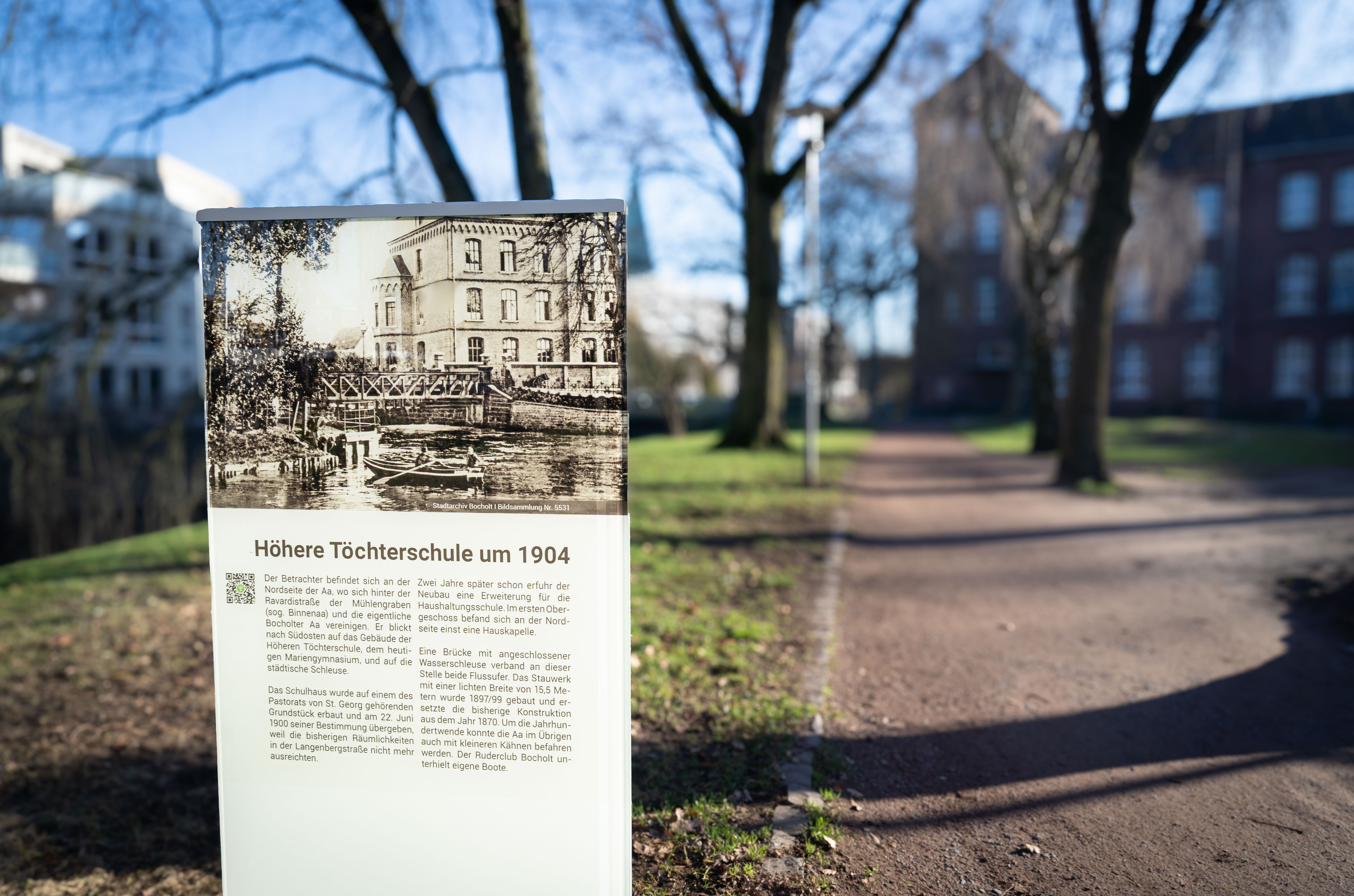
One of the new panels is located at the Mariengymnasium with a view of the old lock system.Three new picture panels bring Bocholt's city history to life
Historical photographs show the changing cityscape // Digital extension through QR codes
The city of Bocholt has installed three new picture boards at prominent locations in the city centre. This brings the historical tour to seven stations that document the changes in the cityscape. Interested citizens can now immerse themselves in the past at Mariengymnasium, Wesemannstraße and Europaplatz.
The aim of the Bocholt picture panels is to show the development of different locations and to make the local history of the town and city tangible on site. So far, four glass panels have already invited visitors to compare historical situations with the current situation. Now three more panels have been added to visualise and permanently anchor traces of different eras in the public space. The historical photographs on the panels serve as a window into the past, while a printed QR code provides access to more in-depth information, which is constantly being expanded. The locations and content were developed by a working group consisting of politicians and administrators.
"It is important to us not only to preserve history in books or archives, but to keep it alive where it took place - in the middle of people's everyday lives", explains Oliver Brenn, Head of Culture and Archives at the City of Bocholt, on behalf of the entire working group. "The combination of historical photography in the urban space and additional digital information creates low-threshold access to Bocholt's history."
One of the new locations is at the Mariengymnasium. The plaque there shows a photograph of the so-called "Höhere Töchterschule" from around 1904. In addition to the school building, the old municipal lock and part of the Bocholter Aa can be recognised in the photo. The picture documents a time when the river could still be navigated with small barges and the Bocholt rowing club even had its own boats there. Another new station was set up on the corner of Wesemannstraße and Schonenberg. Here, the viewer is looking at the old St Agnes Hospital around 1920, including the adjoining St Agnes Chapel and the garden in front, which was used to grow vegetables at the time.
The third new location is Europaplatz. The photograph at this location is dedicated to the so-called "White Convent", a noble ladies' convent on Nobelstrasse. The historic foundation walls of this convent are still marked by white cobblestones in the ground of Europaplatz near the Bustreff, which now contextualises the plaque visually.
With the extension, the project now comprises a total of seven locations. The existing plaques are located in Osterstraße with a view of the Ostermarkt around 1896 and in Neustraße, where Café Eilers is shown. At Benölkenplatz, a photograph from 1941 allows a comparison with the current district court, and at the historic town hall, a photograph shows the market square in 1895. The addition of the new boards further consolidates the network of historical information points in Bocholt's city centre.
© Stadt Bocholt
One of the new panels is located at the Mariengymnasium with a view of the old lock system.