


15. October 2026
Rat und Politik
City Council meeting at the site of a new beginning for democracy
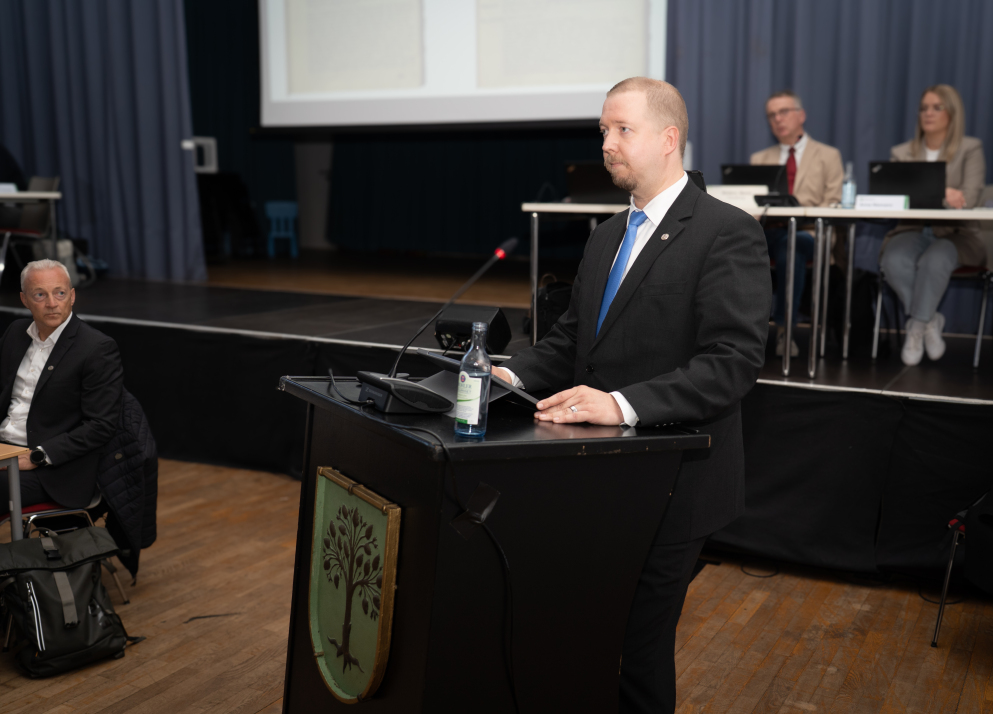
© Stadt Bocholt
The meeting, held in the school hall, was organised to mark the anniversary of the first free local elections following the Second World War. On 13 October 1946, the people of Bocholt had elected a new town council, which convened for its first meeting at St Georg's Grammar School on 30 October 1946. At that time, the town centre was largely destroyed, and the grammar school was one of the few surviving larger buildings. A commemorative plaque still marks both dates today.
The reason for the meeting in the school's assembly hall was the anniversary of the first free local elections after the Second World War. On 13 October 1946, the people of Bocholt had elected a new town council, which held its first meeting on 30 October 1946 at St George's Grammar School. At that time, the town centre was largely destroyed, and the grammar school was one of the few surviving larger buildings. A commemorative plaque still marks both dates today.
First Councillor Björn Volmering had come across this plaque whilst out for a walk in June. It formed the starting point for his speech to the town council on Wednesday evening. The city councillors of 1946 had taken up their posts in a city "where almost everything was in short supply", and in a society which, after twelve years of Nazi dictatorship, had first had to relearn what democratic responsibility meant. This responsibility continues to bind the council and the administration together today. ""We have inherited something that others built up at considerable personal sacrifice. And one day we will pass this city on - to people who will then have to live with the consequences of our decisions"," said Volmering.
A glimpse into the minutes from 1945
Around 85 per cent of the town lay in ruins after the end of the war; the town hall was badly damaged and the council chamber had been burnt out. Volmering illustrated just how dire the situation was by referring to a set of minutes from the city archives. On 17 September 1945, the then municipal executive - which had not yet been elected - discussed the conditions in the city. The acting Lord Mayor, Dr Wilhelm Benölken, openly admitted that he did not know how people could be housed over the winter. At the same time, he announced: "I will do everything I can to keep the people of Bocholt in the town this winter."
According to Volmering, Benölken could not promise success, but he could promise not to simply resign himself to the circumstances. This distinction also applies to local politics today: "We do not have to pretend that we already know every answer. But people are entitled to expect that we will strive to find an answer that does justice to their situation."
Another passage in the minutes shows how directly administrative action affected people's everyday lives. Bernhard Lensing pointed out that a five-year-old child received only a third of the amount of bread allocated to a six-year-old. Benölken expressly thanked him for bringing this to light. "Pointing out a shortcoming is not a disruption of orderly administrative work", said Volmering. Those in positions of responsibility must remain approachable. At the same time, he recalled that the democratic new beginning had not been without its burdens. It had required coming to terms with guilt, with complicity and with turning a blind eye.
Major challenges, limited scope
Volmering rejected the idea of using reconstruction as a metaphor for today's budgetary issues. "Our situation is not comparable to the existential hardship of the post-war period." What links the council and the administration to the city councillors of 1946 is the responsibility to stand up for Bocholt under the conditions of their own time.
With the 2027 budget, the town faces a considerable mountain of necessary investments and infrastructure projects, whilst its financial situation and debt burden limit the scope for action. "It would be disingenuous to give the impression that we could meet all expectations at once", said Volmering. Housing, sustainable schools and nurseries, modern infrastructure, climate protection and reliable fire and disaster response services must be reconciled with responsible financing. Sound finances and social responsibility must not be played off against one another. The administration would play its part by setting clear priorities and reviewing processes and standards.
Volmering expressly praised the work of the city councillors, who carry out their duties on a voluntary basis alongside their jobs and family commitments. Like the elected representatives of 1946, they had not left their city in the hands of others. It is the administration's task to provide them with sound bases for decision-making and subsequently to implement decisions reliably.
Concerns about social cohesion
Volmering said he was particularly concerned about how community life in Bocholt was developing. He noted with concern that trust in institutions and the sense of belonging to a community were waning. This often manifests itself subtly, for example among older people whose social contacts are breaking down, among families who are struggling to cope with everyday life, or among young people who do not see a place for themselves in the town. "We must not confuse the absence of a complaint with the absence of a problem." For the city, this means thinking beyond the boundaries of individual departments. Good opportunities for development and participation should not depend on which neighbourhood someone lives in.
Ahead of the forthcoming discussions, Volmering called for a fair and objective debate on the matter. Political competition must not turn into personal animosity. The city councillors of 1946 could not have known that, eight decades later, Bocholt would be an economically strong and liveable city, and yet they worked towards this future. "We are not only leaving the next generation buildings and financial obligations. We are also leaving them the way we treat one another."
Perhaps in 80 years' time, our successors will also be sitting in
this very spot, read the minutes and wonder how we dealt with the challenges of our time. "I hope that they will then be able to say: They took responsibility. They developed their town further. And in doing so, they did not lose sight of their people. That is the link between then and now. And that is our mission for tomorrow", Volmering concluded his speech to applause.
The 1946 Council
The council elected on 13 October 1946 comprised 27 members, including four women. The CDU provided 14 city councillors, the SPD ten, the Centre Party two and the KPD one. Unlike the body appointed by the British military government in September 1945, this council was the result of a free, fair and secret election. At their first meeting, the city councillors elected Dr Wilhelm van Laak (CDU) as Lord Mayor. He succeeded Dr Wilhelm Benölken, whom the British had appointed in March 1945. Until the founding of the Federal Republic in 1949, the military government retained considerable influence over local government decisions.
The full text of the speech by First Councillor Björn Volmering is available on the City of Bocholt's website at www.bocholt.de.