


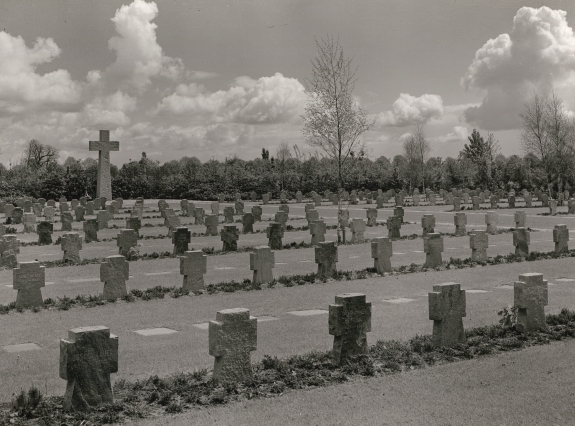
The Memorial Cemetery for the Victims of the War 1939-1945
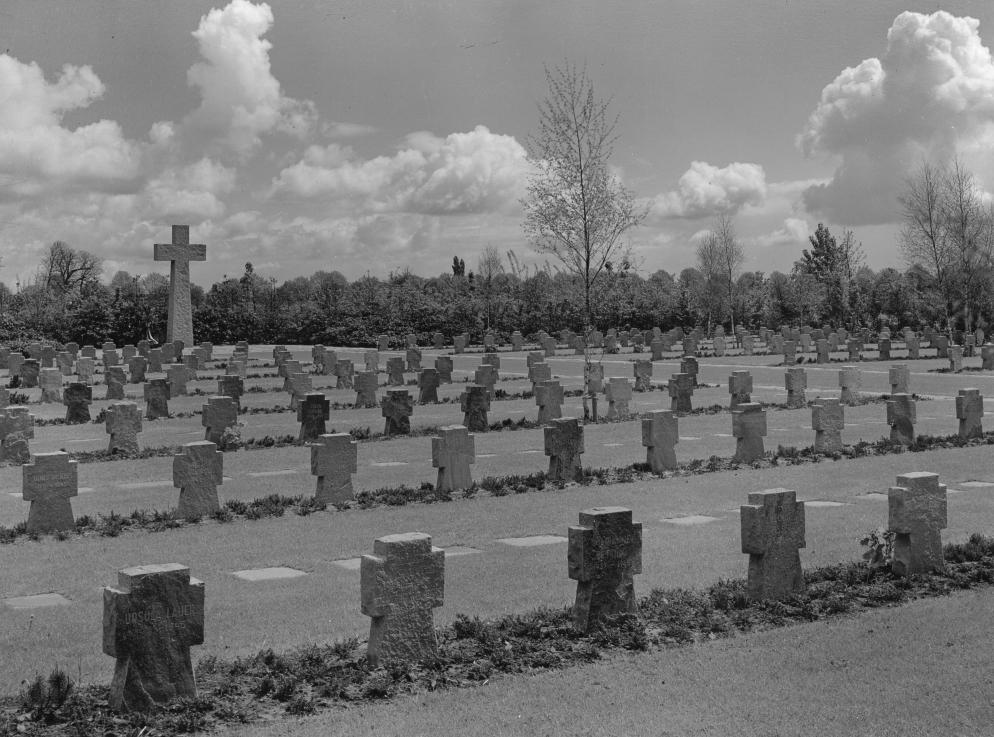
© Stadtarchiv Bocholt, Bildsammlung Nr. 2975.
Neu angelegter Ehrenfriedhof 1956On All Saints' Day 1954, the town council unveiled the newly designed memorial at the municipal cemetery on Blücherstraße in honour of the soldiers and civilian victims from Bocholt who lost their lives during the Second World War (1939-1945). Around 700 people lost their lives here during this period as a result of the ravages of war.
Until then, they had been laid to rest in four different burial plots within the cemetery; they were now given a unified and dignified final resting place in the centre of the cemetery grounds.
A dignified memorial
Planning for the new memorial cemetery began in 1951. Following two years of project work, experts from the North Rhine-Westphalia regional branch of the German War Graves Commission gave their approval to the designs produced by the municipal Parks and Cemeteries Department.
These envisaged the creation of a lawn-covered area with a continuous central axis leading to a four-metre-high cross carved from Ruhr sandstone. From the wide central path, individually laid stone slabs provided access to the respective graves. The grave crosses were made from the same stone as the central cross.
Four graves were grouped together to form a memorial cross, with two names carved on the front and back wherever possible. The inscriptions followed a standard format, always including the first name and surname as well as the year of birth and death of the war victim.
In keeping with its quiet and modest character, snow heath (Erica carnea) was planted between the graves. The gardeners planted young birch trees in loose groups, using deciduous trees only for the outer border. Douglas firs grew behind the high cross.
Permanent burial rights
The new cemetery of honour was linked to the existing site, situated at the roundabout at the junction of the main paths. There lay the victims of the First World War, 1914-1918. The two memorial sites were now linked by an avenue running north-east, lined with birch trees, which in turn incorporated war graves on both sides of the path.
Work on the 9,600 square metre burial ground began in the spring of 1954. Permanent staff and conscripted labourers helped to exhume the remains and transfer them to the new burial ground. On 1 November 1954, thousands flocked to the cemetery to commemorate their loved ones and the victims of the bombing at the new memorial site, the upkeep of which was taken over by the city, thereby ensuring the victims a permanent resting place.